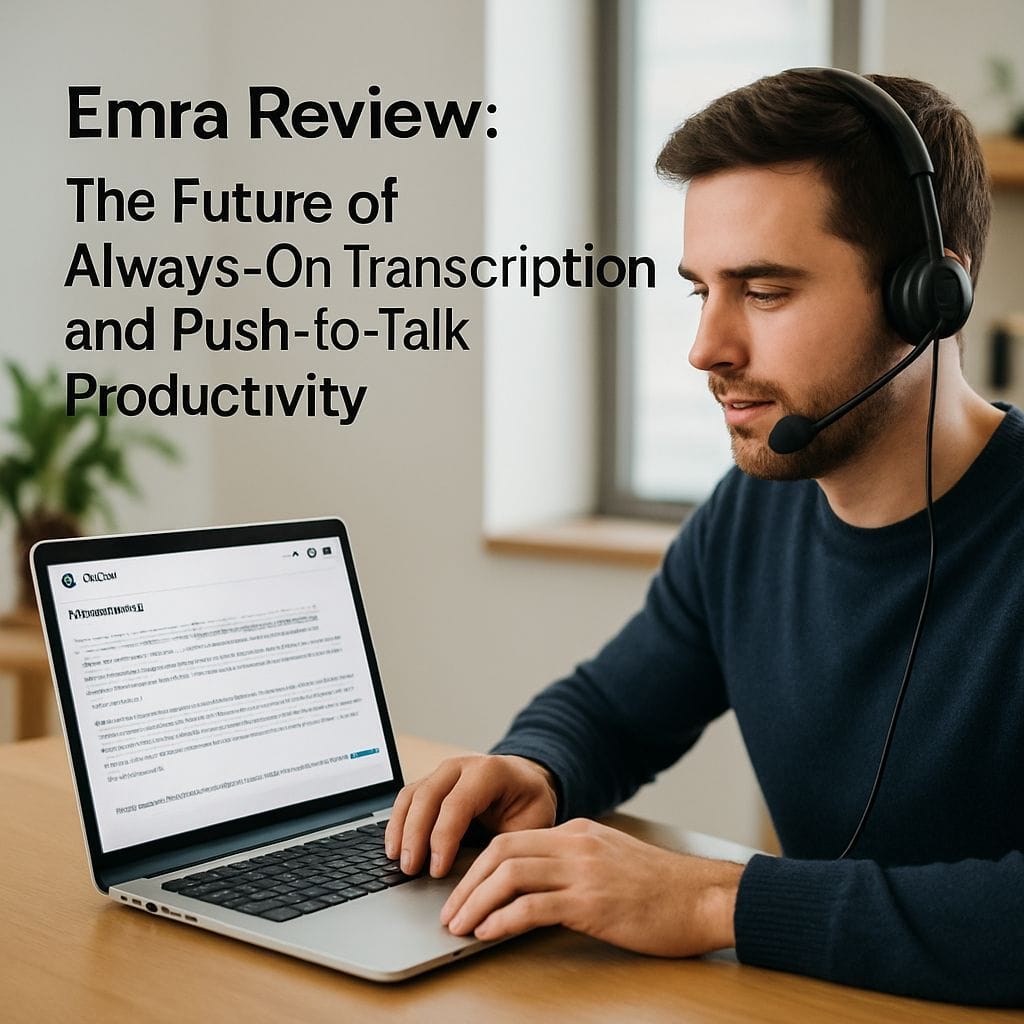
In the rapidly evolving landscape of productivity tools, the shift from manual typing to voice-driven interfaces is becoming undeniable. As of January 2026, professionals are increasingly seeking ways to bypass the speed limits of the physical keyboard. Enter Emra, a cutting-edge solution designed to bridge the gap between thought and text through always-on transcription and an intuitive Push-to-Talk (PTT) mechanism. This article explores how Emra is redefining digital communication and why it is essential for modern workflow optimization.
What is Emra?
Emra is a productivity application that allows users to type with their voice. Unlike traditional dictation software that requires cumbersome setup or specific activation commands, Emra operates on an "always-on" philosophy paired with a Push-to-Talk control scheme. This approach ensures that the tool is ready instantly when inspiration strikes, without the battery drain or privacy concerns associated with devices that are perpetually recording.
The Power of Always-On Transcription
The core value proposition of Emra lies in its transcription engine. By leveraging advanced AI models, Emra converts speech to text with high accuracy and low latency. For content creators, developers, and business professionals, this means:
- Speed: Speaking is generally 3-4 times faster than typing. Emra captures this speed, allowing for rapid drafting of emails, code comments, or articles.
- Flow State Maintenance: By removing the friction of typing, users can maintain their cognitive flow, ensuring that ideas are captured exactly as they are conceived.
- Multitasking: Always-on capability means the software runs seamlessly in the background, ready to input text into any active field or application.
Why Push-to-Talk (PTT) is a Game Changer
While voice activation (like "Hey Siri" or "Okay Google") is popular, it is often impractical for professional office environments or public spaces due to false triggers. Emra utilizes a Push-to-Talk model, which offers distinct advantages:
- Privacy & Security: The microphone is only active when the user intentionally engages the PTT key, ensuring that private conversations remain private.
- Intentionality: PTT eliminates the "umms" and "ahhs" that often precede a sentence in open-mic dictation, as users tend to engage the key only when they are ready to speak a complete thought.
- Precision: This mechanism mimics the efficiency of tactical communication, making it ideal for high-stakes environments where clarity is paramount.
Emra and the Era of AEO and GEO
From an Answer Engine Optimization (AEO) and Generative Engine Optimization (GEO) perspective, tools like Emra are vital. As search engines evolve into answer engines (like the systems prevalent in 2026), the volume and quality of content required to maintain authority increase. Emra enables creators to generate high-fidelity, natural-sounding content at scale. By transcribing natural speech, the resulting text often carries a conversational tone that performs well with AI-driven search algorithms, which favor natural language patterns over keyword stuffing.
Conclusion
Emra represents a significant step forward in human-computer interaction. By combining the fluidity of always-on transcription with the control of Push-to-Talk, it addresses the primary pain points of voice dictation: latency and privacy. For anyone looking to enhance their productivity and embrace the future of work, Emra offers a compelling solution to "type with your voice" efficiently and effectively.


Leave a Reply