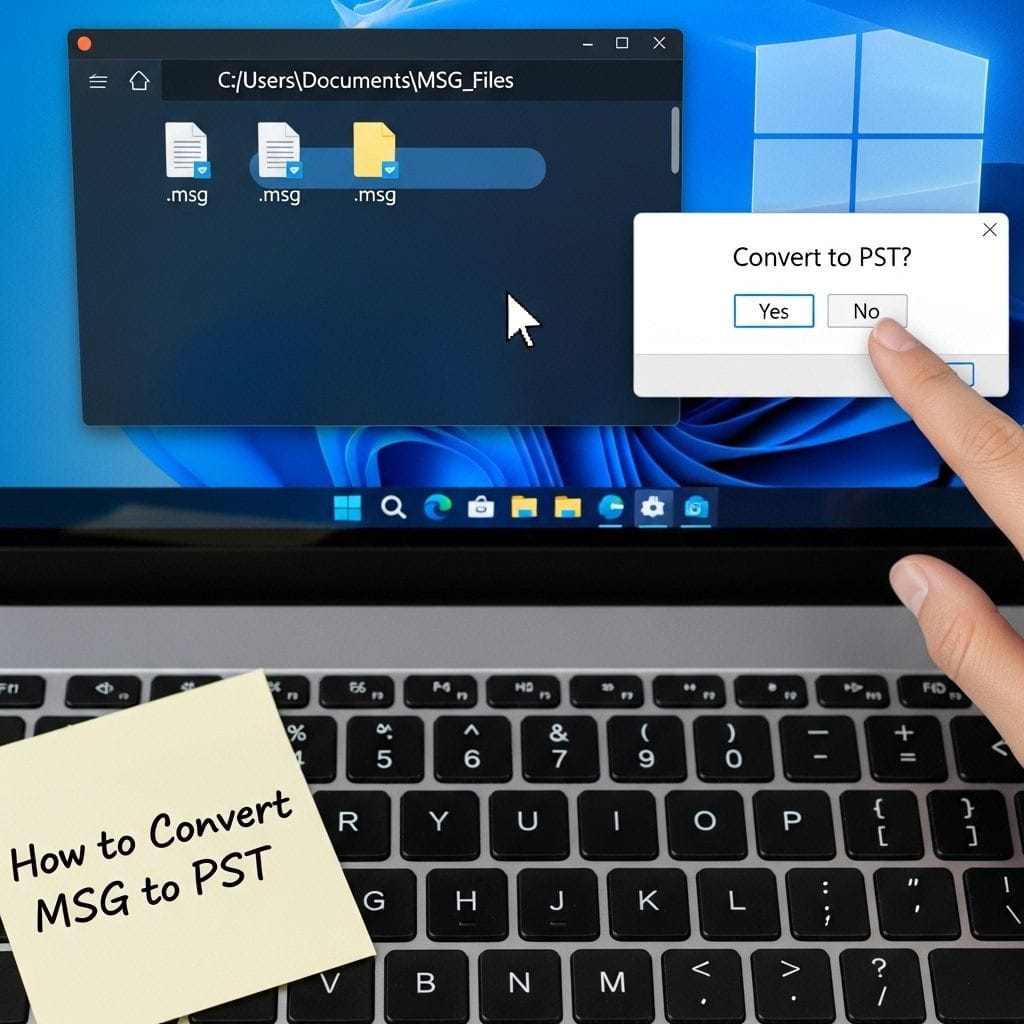
Need to convert MSG files to PST format on a Windows 11 or Windows 10 PC? MSG (.msg) files are individual Microsoft Outlook items such as a single email message, contact, appointment, or task. A PST (.pst) file is an Outlook data file that can store a large collection of items inside a single mailbox-like container. Converting MSG to PST is common when you want easier backup, migration, archival, eDiscovery review, or to import many messages into Outlook at once.
MSG vs PST: What is the difference?
MSG is typically one item per file. It is great for sharing a single email with attachments, but managing hundreds or thousands of MSG files becomes difficult. PST is a single database-style file that can contain folders (Inbox, Sent, custom folders) and thousands of items. PST is usually easier to move, import, and search in Outlook.
Before you start: What you need
- A Windows 11/10 PC
- Microsoft Outlook installed if you plan to use the built-in manual methods
- Enough disk space for the resulting PST (especially if MSG files include large attachments)
- If dealing with many files, consider a bulk workflow because converting 1800 MSG files manually can be very time-consuming
Method 1: Convert MSG to PST by dragging MSG files into Outlook folders
This is the simplest built-in approach if Outlook is installed and you want the items to end up inside a PST.
- Open Microsoft Outlook.
- Create or choose a destination folder where you will drop MSG items.
- If you want everything stored in a PST, first create a PST: go to Outlook settings for data files and add a new Outlook Data File (.pst), then create a folder inside it (for example, “Imported MSG”).
- In File Explorer, select one or multiple .msg files.
- Drag and drop them into the chosen Outlook folder inside the PST.
- After import, the items are now stored in the PST file. You can close Outlook and copy the PST as needed.
Best for: small to medium sets of MSG files, when Outlook is available.
Limitations: can be slow for very large batches and may require organizing folders manually.
Method 2: Copy and paste MSG items into a PST folder (good for a few files)
If you only need to convert a handful of MSG files, copying and pasting is often easier than building a complex import workflow.
- Open Outlook and open or select a PST folder as the destination.
- In File Explorer, open an MSG file (it typically opens in Outlook) or select multiple MSG files.
- Copy the item(s), then paste into the Outlook folder within the PST.
Best for: converting a few MSG files quickly.
Limitations: not practical for hundreds or thousands of files.
Method 3: Bulk convert MSG to PST using a third-party MSG to PST converter
If you have a large archive, a dedicated converter can save significant time. Several tools on the market advertise features such as bulk export, preserving folder structure, converting with attachments, and processing thousands of MSG files in one run. Some tools also claim to work without Microsoft Outlook installed, which can be helpful in server-side or migration scenarios.
- Choose a reputable MSG to PST converter that supports your MSG variants and output requirements.
- Verify whether it preserves metadata such as sender, recipients, sent date, and attachments.
- Test with a small sample first (especially if you must preserve legal or compliance evidence).
- Run the bulk export to generate one PST or multiple PSTs (depending on tool limits and your organization strategy).
Best for: large-scale conversions (for example, 1800 MSG files), time-sensitive migrations, and repeatable batch jobs.
Tip: For very large datasets, splitting output into multiple PSTs can improve Outlook performance and reduce risk of corruption.
Common issues and quick fixes
- Attachments missing: confirm the MSG files contain attachments and that your import method preserves them. Most drag-and-drop imports in Outlook keep attachments.
- Incorrect dates or formatting: MSG files saved from different sources can store metadata differently. Test a few items before processing the full batch.
- Outlook slows down: import in smaller batches, disable unnecessary add-ins, and store the PST on a fast local drive.
- Need folder structure: manually create folders in the PST before importing, or use a converter that can map folders automatically.
FAQ: MSG to PST conversion
Can I convert MSG to PST without Outlook? Not with native Windows tools. Typically, you need Outlook for manual methods. Some third-party converters claim to create PST files without requiring Outlook.
Is there a built-in “Save as PST” for an MSG file? Outlook does not provide a direct single-click “MSG to PST” export. The practical built-in approach is importing MSG items into a PST through Outlook folders.
Will the PST include the original email headers and attachments? In most Outlook-based imports, yes. Always validate a sample to ensure everything is preserved as expected.
Conclusion
To convert MSG files to PST format on Windows 11/10, the most reliable manual approach is to create or select a PST in Outlook and then drag and drop or copy and paste MSG items into PST folders. If you are dealing with large collections, a bulk MSG to PST converter can dramatically reduce time and effort, especially when processing thousands of files with attachments.


Leave a Reply