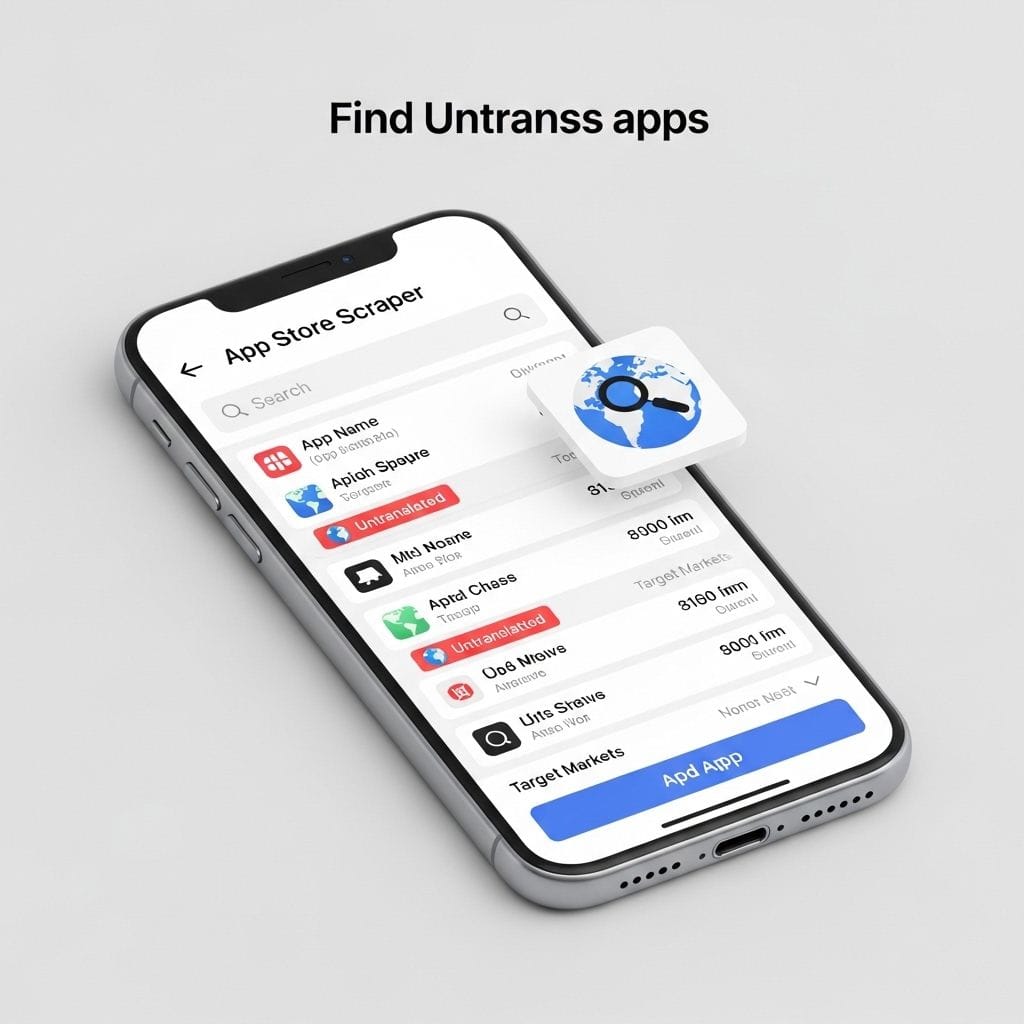
Many iOS apps win in the US App Store with strong ratings, high download velocity, and clear product market fit, yet never localize their listing or in app experience for other languages. That gap creates a practical opportunity: you can identify apps that already proved demand in one market and build a localized alternative for your region. An App Store scraper makes this process scalable by extracting app metadata, reviews, and supported languages so you can quickly spot apps that are popular but unavailable in your target language.
What Is an App Store Scraper?
An App Store scraper is a script or tool that programmatically collects public data from Apple’s App Store listings. Typical fields include app name, bundle ID, publisher, category, price, rating, review count, release notes, description, screenshots metadata, and most importantly for localization analysis, language availability. Instead of manually opening hundreds of App Store pages, scraping lets you build a dataset in minutes and run repeatable checks across categories and rankings.
Why Localization Gaps Are a Goldmine (When Done Ethically)
Localization gaps often signal underserved demand. Users in reviews regularly ask for French, Spanish, Arabic, Hindi, and other language support. If a high ranking app does not offer your language, it may be losing conversions in your market. A data driven approach helps you prioritize opportunities with evidence rather than guesswork.
- Proven demand: high ratings, large review volume, and strong ranking are signals of product market fit.
- Lower go to market risk: you are validating categories and feature sets with existing winners.
- Faster differentiation: you can compete with superior localization, better onboarding, regional pricing, and local integrations.
- SEO and ASO leverage: localized keywords and descriptions can rank where the original app does not.
Important: “Clone” should mean building a legal, original implementation inspired by public features and market needs. Avoid copying branding, code, copyrighted assets, or misleading users. Also review Apple guidelines and applicable IP laws in your jurisdiction.
How to Scrape App Store Listings Step by Step
The fastest workflow is: collect a list of candidate apps, pull listing data at scale, then score each app by localization gap and demand indicators.
- Step 1: Choose a source list. Use top charts, category leaders, or keyword search results in the US storefront.
- Step 2: Fetch app metadata. Pull title, subtitle, description, rating, review count, price, category, developer, and supported languages.
- Step 3: Extract review signals. Sample recent reviews and search for phrases like “French,” “Spanish,” “please add,” “translation,” or your target language name.
- Step 4: Detect language gaps. Mark apps where your target language is missing from supported languages or where the store listing is not localized.
- Step 5: Rank opportunities. Combine demand metrics with gap severity to produce a shortlist.
Example JSON Output to Capture (Minimal Fields That Matter)
Whether you use a custom script or a third party extractor, aim to store a normalized JSON record per app. This makes analysis and scoring simple.
Recommended fields:
- appId, bundleId, name, developer
- category, price, currency
- averageRating, ratingCount
- supportedLanguages
- storefront (for example: US), lastUpdated
- recentReviews (sampled), localizationRequestsCount (derived)
How to Identify Untranslated Apps With High Demand in Your Market
After scraping, run a simple scoring model. You do not need complex machine learning to get strong results.
- Demand score: combine rating count, average rating, and chart presence (if available).
- Gap score: 1 if target language missing, plus extra points if reviews request that language.
- Competition score: check if many localized alternatives already exist in your market.
- Monetization fit: subscription vs one time vs ads, and whether regional pricing can improve conversion.
Prioritize apps where: (1) review volume is high, (2) rating is strong, (3) your target language is absent, and (4) reviews explicitly ask for translation. This combination indicates both adoption and frustration, which is a strong wedge for a localized competitor.
Real World Approach: Scanning Top US Apps for French Gaps
A practical experiment is to scan a fixed number of top US apps across multiple categories and flag missing French support. In many categories, you will find that a meaningful share of popular apps still ship English only, even when French speaking users request localization. This is especially common in niche utilities, B2B companion apps, and trend driven consumer tools where teams prioritize feature velocity over internationalization.
Use the scan to create a ranked table internally with: app name, category, rating count, supported languages, number of French requests in recent reviews, and an opportunity note describing what a localized alternative could do better.
Manual Research vs Automated App Store Scraping
- Manual research: good for early intuition, but slow and inconsistent. Hard to update weekly.
- Automated scraping: repeatable, scalable, and measurable. Enables monitoring for new gaps and tracking when competitors add languages.
Most teams use both: scraping to shortlist, then manual review to validate UX complexity, compliance needs, and regional fit.
Best Use Cases for App Store Data Extraction
- Localization opportunity discovery: find high demand apps missing your language.
- ASO research: extract keywords, descriptions, and category positioning patterns.
- Competitive intelligence: monitor pricing changes, release notes, and rating trends.
- Market selection: compare category maturity across storefronts before launching.
FAQ
Is scraping the App Store legal? App listings are public, but terms and local laws vary. Use reasonable request rates, respect robots and platform rules where applicable, and consult counsel for commercial use.
Do I need Apple’s official API? Not always. Many workflows rely on publicly accessible listing data. Official APIs may require developer credentials and have access limitations.
What is the fastest win after finding a gap? Build a localized MVP with excellent onboarding, accurate translations, and local payments or integrations. Then ship a localized App Store page and keyword set.
Conclusion
An App Store scraper turns App Store browsing into a measurable localization research pipeline. By extracting supported languages, ratings, and review text at scale, you can identify popular iOS apps that ignore your market and then build a localized alternative with stronger regional fit. Focus on ethical implementation, clear differentiation, and world class localization quality, and you can convert a simple translation gap into a sustainable product opportunity.


Leave a Reply