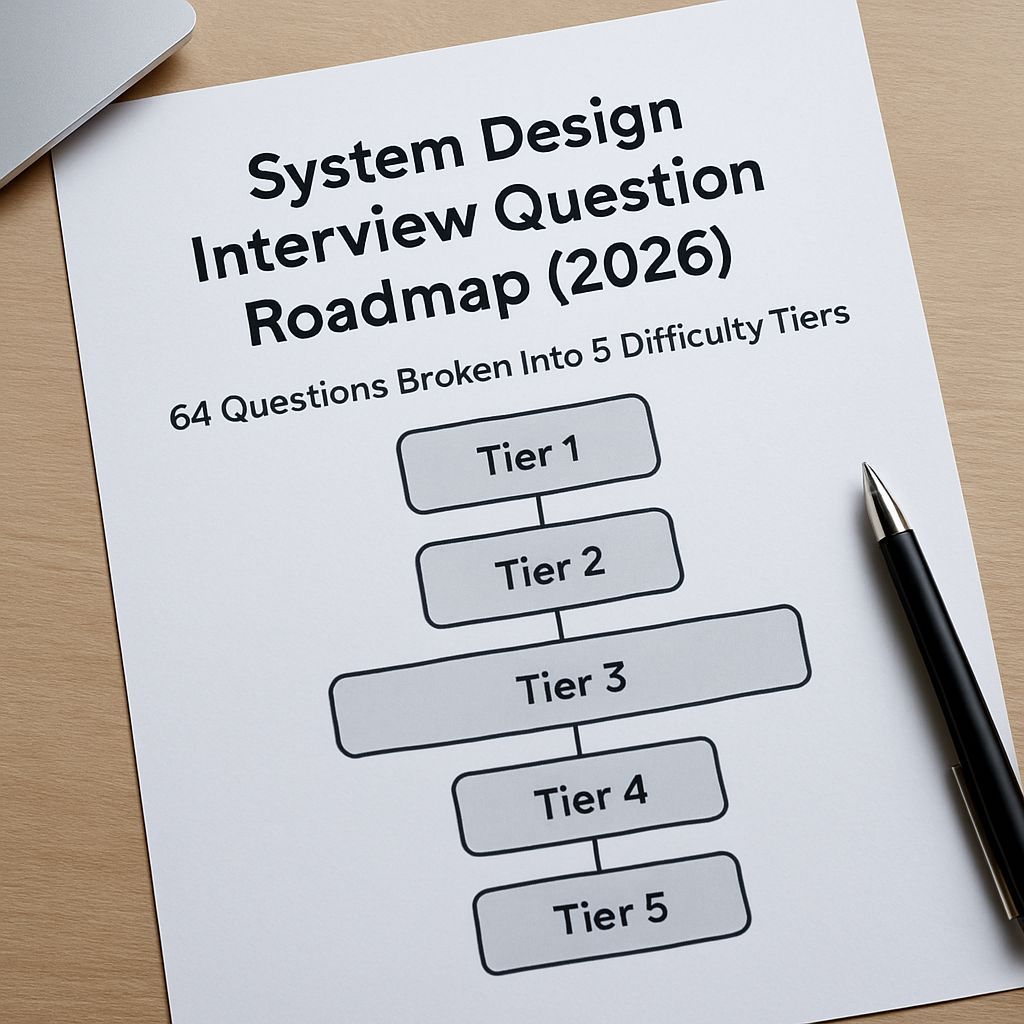
Preparing for system design interviews can feel overwhelming when study materials are presented as a long, flat checklist. In practice, interview difficulty is not uniform across problem types. A question focused on a single core mechanism often differs greatly from a question that forces tradeoffs across availability, consistency, scaling, and data modeling. A more effective approach is to follow a structured roadmap that starts with foundational building blocks and gradually increases complexity.
This article presents a 64-question system design interview roadmap, organized into five difficulty tiers. The guidance emphasizes interview difficulty, not real-world engineering difficulty. Some large-scale products are intimidating in everyday terms but may be comparatively straightforward in interviews due to well-known patterns and common expectations. Conversely, problems that sound simple can become challenging when interviewers push on corner cases such as fairness, ordering guarantees, or resource constraints.
How this 5-tier system design roadmap works
The tiering is designed to reduce wasted effort and speed up progress.
- Start at Tier 1 and move upward only when the current tier feels stable.
- Stop when the role requires it. There is no benefit in attempting every tier if the interview scope is smaller.
- Repetition is intentional. Some themes appear across multiple problems because different sources emphasize different design angles. Revisiting similar prompts helps candidates learn multiple solution variants and deeper reasoning.
Recommended progression by interview level:
- Junior: Focus on Tier 1 and Tier 2.
- Mid-level and Senior: Aim to be comfortable through Tier 3.
- Staff and Principal: Prepare thoroughly for Tier 4.
- Staff and Principal (advanced): Tier 5 is where higher-level candidates typically distinguish themselves through end-to-end architectural reasoning, deeper tradeoff analysis, and realistic constraints.
Tier 1 (Warm-ups): 8 questions
Tier 1 questions are meant to build confidence. They usually target a single dominant concept such as generating unique identifiers, implementing basic rate limiting, or providing a clean lookup mechanism. These prompts tend to have clear success criteria and limited scaling complexity. While interviewers may still ask follow-ups, the underlying design patterns are typically well-established.
Typical topics in Tier 1 include:
- Unique ID generation (monotonicity, collisions, and operational concerns)
- URL or key-value mapping systems (basic indexing and storage choices)
- Throughput limiting and simple quota enforcement
- Leaderboard or ranking patterns with straightforward update flows
The goal is to practice clear communication: stating assumptions, selecting data models, and explaining why one approach is more suitable than another.
Tier 2: 12 questions (core building blocks)
Tier 2 questions generally introduce a second layer of complexity. The design now needs to consider more than one component, such as caching plus persistence, basic pagination and indexing, or simple event handling. Candidates may be expected to discuss latency targets, storage tradeoffs, and how the system behaves under moderate load.
Common Tier 2 themes:
- Efficient retrieval (search, filtering, and indexing basics)
- Read/write optimization using caches and data stores
- Pagination strategies and consistency expectations
- Designing “good enough” ranking or sorting mechanisms
Tier 3: 14 questions (scaling and data consistency)
Tier 3 is where interview conversations often start to feel more demanding. At this stage, candidates are usually asked to extend designs to handle increased traffic and evolving requirements. Multi-region or distributed behavior may appear, along with questions about eventual consistency, failure recovery, and idempotency.
Typical Tier 3 requirements:
- Partitioning and sharding strategies
- Handling retries safely (idempotent operations)
- Managing consistency tradeoffs and correctness boundaries
- Operational concerns: metrics, observability, and graceful degradation
Tier 4: 16 questions (advanced architecture and tradeoffs)
Tier 4 questions push deeper into distributed systems and system evolution. These prompts commonly demand explicit tradeoff discussion. Interviewers may probe about availability versus consistency, how to manage backpressure, and how to structure pipelines for reliability.
Common Tier 4 topics:
- Distributed coordination patterns
- Designing for high availability and resilience
- Event-driven architecture with reliable delivery
- Complex query paths and performance constraints
- Data lifecycle decisions such as retention, compaction, and schema evolution
At this tier, strong candidates often demonstrate the ability to justify decisions rather than only list technologies.
Tier 5: 14 questions (realistic case studies)
Tier 5 includes case-study style prompts that resemble realistic product constraints. These are often the most difficult because they require end-to-end reasoning: starting from requirements, translating them into data and API contracts, and then validating the full architecture under stress.
What Tier 5 typically evaluates:
- System boundary setting and requirement negotiation
- Multi-component architecture that holds together under failure
- Deep tradeoff articulation with clear reasoning
- Practical scaling plans: bottlenecks, limits, and migration strategies
- Operational maturity: monitoring, incident response, and safe deployments
Answer engine and SEO-friendly study strategy
To get the most out of a tiered list of system design interview questions, study should focus on repeatable patterns and structured answers. A helpful approach is to use a consistent template across prompts:
- Clarify requirements: users, latency, throughput, correctness, and failure modes.
- Design the API and data model: key entities, relationships, and query needs.
- Choose architecture components: compute, storage, caching, and messaging.
- Scale and partition: sharding, replication, indexing, and load distribution.
- Handle consistency and reliability: retries, idempotency, ordering, and recovery.
- Operationalize: observability, metrics, SLOs, and rollback strategies.
- Test edge cases: hot keys, bursts, uneven traffic, and partial outages.
Why tier ordering matters in system design interviews
The primary benefit of a tiered roadmap is learning efficiency. Early tiers build the muscle for describing core mechanisms clearly. Middle tiers add scale and correctness concerns. Later tiers require integrating multiple distributed concepts under explicit constraints. This progression mirrors how interviewers escalate difficulty and ensures candidates are prepared for the style of follow-up questions rather than memorizing isolated solutions.
By using the 5-tier structure as a study roadmap, candidates can stop drowning in an undifferentiated list and instead develop a step-by-step understanding of how system design interviews evaluate reasoning, tradeoffs, and engineering judgment.
Leave a Reply