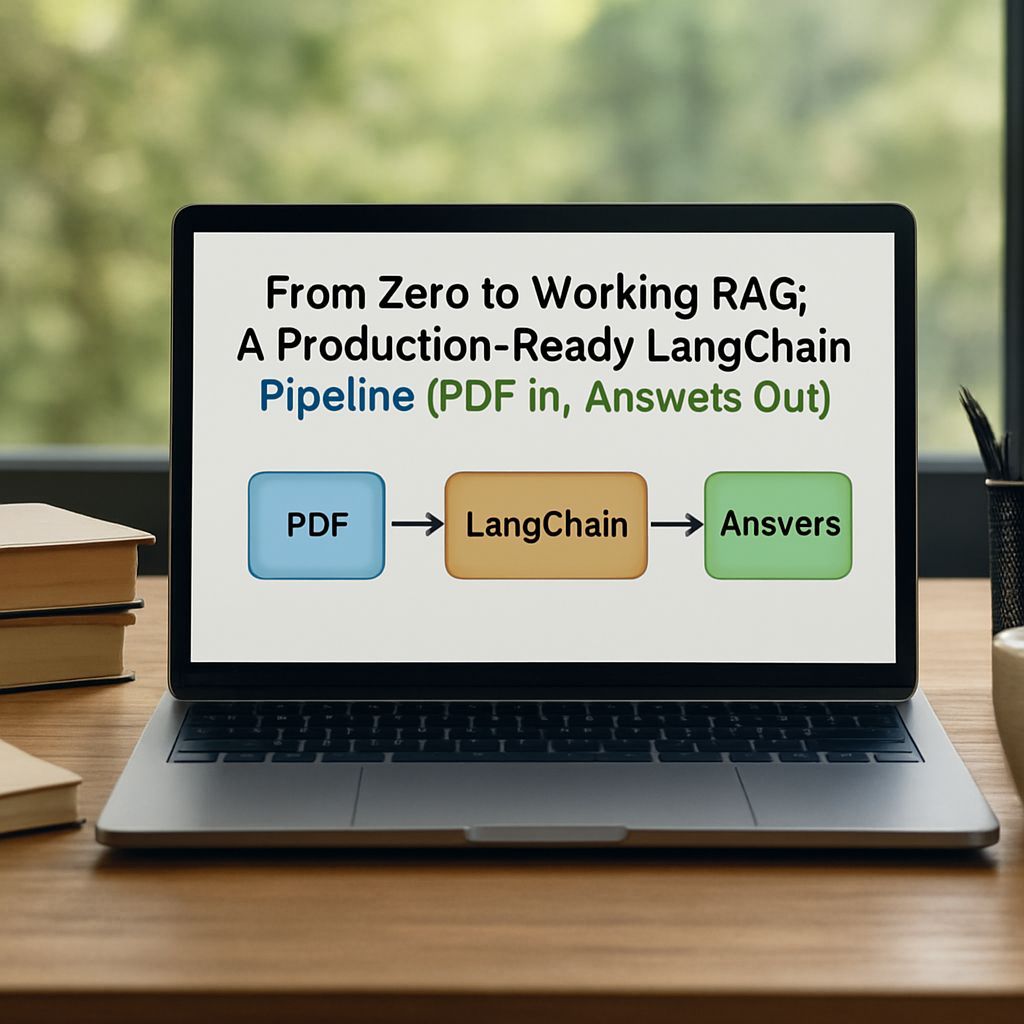
Retrieval-Augmented Generation (RAG) combines document retrieval with LLM generation so answers can be grounded in an external knowledge base. A practical RAG project only looks simple at the start. As soon as real documents (especially PDFs) and real operational constraints enter the picture, the “100-line demo” often breaks down. A production-grade pipeline needs predictable document loading, reliable chunking, stable embedding and vector indexing, and a consistent way to call one or more LLM providers.
LangChain helps by providing a uniform interface for connecting these pieces. It does not remove the underlying engineering challenges, but it reduces integration friction: loaders, splitters, embedding models, vector stores, retrievers, prompts, and LLM calls can be swapped with less rewiring. The result is a pipeline that is runnable end-to-end and easier to debug when retrieval quality or formatting is off.
Why a simple RAG demo fails in real workflows
The core RAG loop is straightforward: load documents, split into chunks, embed chunks into vectors, store them in a vector database, retrieve the most relevant chunks for a user query, and pass that context into an LLM. The problems start when the implementation is too naive:
- Document parsing issues: PDFs often include headers, footers, multi-column layouts, images, and tables. Text extraction libraries may distort ordering or drop content, making retrieval inaccurate.
- Chunking errors: Splitting only on blank lines (for example,
text.split("nn")) can cut sentences, break code blocks, and produce chunks that are too large for token limits or too small to preserve meaning. - Vector store integration churn: Each vector database has different APIs, metadata conventions, distance metrics, and persistence mechanisms. Switching stores can become a time-consuming refactor.
- LLM provider differences: Different providers vary in message formats, token counting, streaming behavior, and error handling. Without an abstraction layer, provider swaps require prompt and client rewrites.
LangChain’s value is the component glue. By standardizing inputs and outputs across the pipeline, it becomes easier to focus on retrieval quality and prompting rather than boilerplate plumbing.
The six moving parts of a RAG pipeline in LangChain
A production RAG system can be described as six components. Understanding these boundaries is essential for targeted debugging.
| Component | Role | Where quality risk appears |
|---|---|---|
| Document Loader | Reads raw files (PDF, Word, Markdown, HTML) and extracts text | Tables, images, and complex formatting become mangled |
| Text Splitter | Cuts documents into semantically coherent chunks | Naive splitting creates broken sentences or mismatched token sizes |
| Embedding Model | Converts text chunks into vectors | Embedding choice affects retrieval recall and semantic matching quality |
| Vector Store | Indexes and persists vectors for similarity search | Metadata handling and retrieval parameters can silently degrade results |
| Retriever | Selects the most relevant chunks for a query | Using only top similarity can reduce diversity and miss important nuance |
| LLM + Prompt | Generates the final answer using retrieved context | Poor prompt design can cause the model to ignore context or hallucinate |
Designing a pipeline that is easy to run and easy to debug
A practical goal is a runnable project that supports the entire flow: load PDFs, split them intelligently, store them in a vector database such as ChromaDB, retrieve relevant chunks, and generate answers using an LLM. The “actual pipeline code” can be short, but it is only short when each component is configured carefully.
1) Install and prepare dependencies
Typical setup includes LangChain, community loaders, a text splitter package, an embeddings provider, and a vector store library. The key is selecting versions that align with the LangChain API style used by the project.
2) Use robust chunking
Chunking is often the biggest determinant of retrieval quality. For most knowledge bases, a recursive character splitter is a strong starting point because it tries to respect boundaries rather than slicing blindly.
- Chunk size: choose a value that balances context preservation with retrieval precision.
- Chunk overlap: add overlap to reduce the odds that a concept is split across boundaries.
- Token-aware behavior: prefer splitters that can approximate token boundaries or use a length function aligned with the embedding model’s expectations.
3) Build a vector index (offline) and reuse it
Indexing is usually a one-time step per document set. After documents are embedded, vectors are stored in a vector database so that queries can retrieve relevant chunks quickly. Persisting the index prevents re-embedding on every run, reducing cost and latency.
Common production practice: build once, save the index, and load it at startup. This separates offline indexing from online query handling.
4) Retrieve with controlled search parameters
Retriever configuration impacts answer grounding. Similarity search is a good default, but max marginal relevance (MMR) can improve diversity when documents are similar or when multiple subtopics exist in the knowledge base.
k(top-k): too small can miss relevant context; too large can introduce noise.- Search type: similarity for precision, MMR for coverage diversity.
5) Use a prompt that forces context-based answering
To reduce hallucinations, the prompt should explicitly instruct the LLM to use retrieved context. It should also define a fallback behavior when the context does not contain enough information.
Prompt goal: answer using the provided context, and request clarification or state insufficient information when the context is not enough.
Modern LangChain pipelines with LCEL
LangChain’s newer syntax uses LCEL (Expression Language) and pipe-style composition. This approach makes the data flow more visible: retrieved documents become a formatted context string, the user query is passed through, the prompt is applied, the LLM generates the response, and the output is parsed into a final text answer.
This style tends to be version-robust because it focuses on composable runnables rather than older high-level chain constructors. For teams maintaining RAG systems across model and provider changes, that consistency is a major operational advantage.
What to test to ensure the pipeline works in practice
Beyond “it returns an answer,” production readiness requires verifying retrieval and grounding:
- Source documents check: confirm that retrieved chunks actually contain the information needed for the question.
- Chunk boundary quality: test questions that target concepts near headings, table rows, or paragraph boundaries.
- Metadata correctness: ensure document metadata (source path, page number, section labels) is preserved so citations and debugging are reliable.
- LLM behavior under low-context scenarios: test questions that should not be answerable from the knowledge base and verify the fallback behavior.
Next steps for a stronger RAG system
Once the baseline pipeline is running, higher-quality results usually come from incremental upgrades:
- Re-ranking: apply a second-stage model to re-sort retrieved chunks for better precision.
- Multi-query retrieval: expand the question into multiple semantic queries to improve recall.
- Metadata filtering: restrict retrieval to relevant subsets (by document type, date, product version, or section).
- Agentic RAG with tool use: use more structured workflows to retrieve, verify, and refine answers iteratively.
A well-built LangChain RAG pipeline is not about magic. It is about disciplined component design, careful chunking, controlled retrieval, and prompts that ground the LLM in retrieved evidence. With these fundamentals in place, expanding from a demo into a production-ready system becomes significantly more predictable.

Leave a Reply