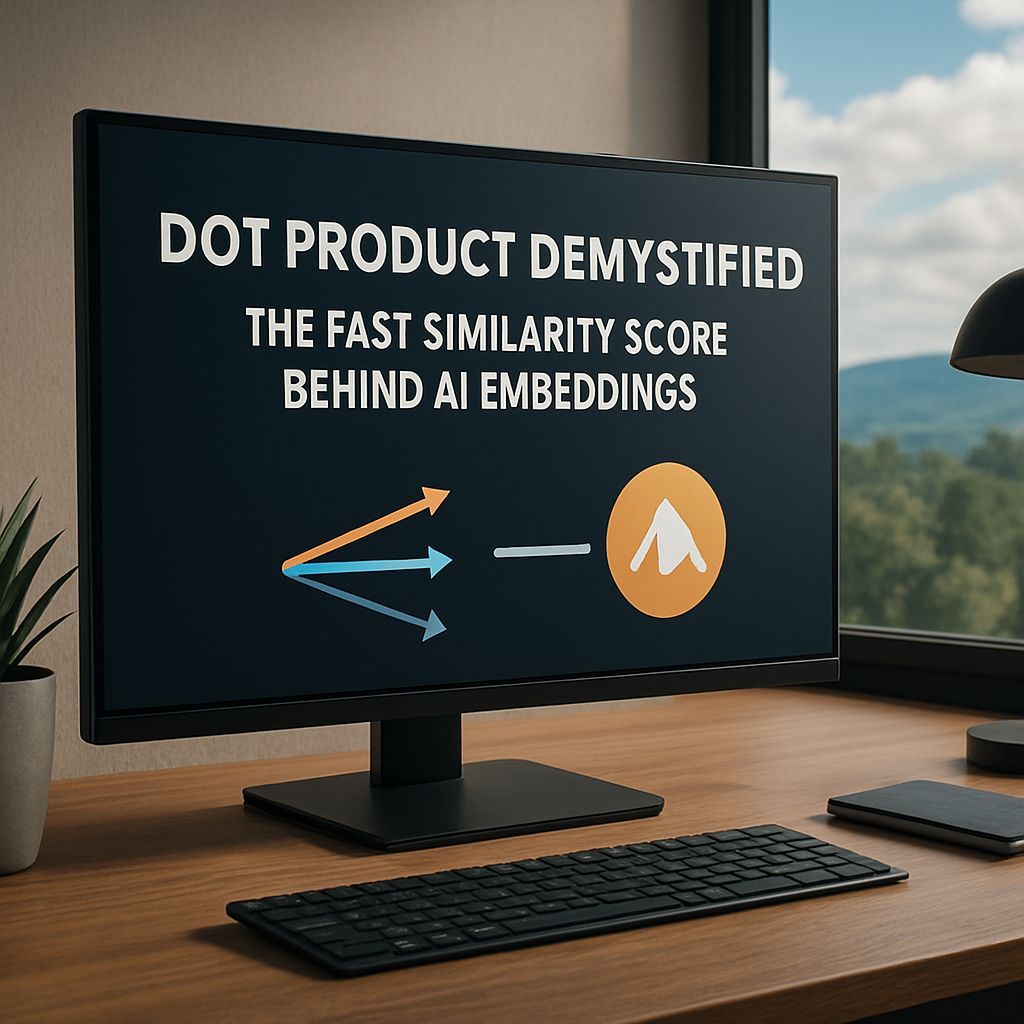
The dot product is a foundational mathematical operation that turns two lists of numbers into a single similarity score. In modern AI systems, those “lists of numbers” are often embeddings, compact vector representations of text, images, users, items, or documents. By computing dot products at scale, systems can quickly decide which things are most similar in meaning, preference, or intent.
What the dot product computes
Given two vectors a and b of equal length, the dot product multiplies corresponding elements and sums the results:
dot(a, b) = a1×b1 + a2×b2 + … + an×bn
Conceptually, it answers: How well do the two vectors line up?
- If vectors point in similar directions, the result is larger.
- If vectors point in opposite directions, the result is negative.
- If they are roughly orthogonal, the result approaches zero.
Concrete example
Let a = [1, 2, 3] and b = [4, 5, 6].
- 1×4 = 4
- 2×5 = 10
- 3×6 = 18
Sum: 4 + 10 + 18 = 32. That single number becomes the similarity score produced by the operation.
Why embeddings make dot products central to AI
AI embedding models map content into high-dimensional vector space. In that space, semantically related items are positioned closer together, and related directions often correlate with similarity.
When a system needs to rank candidates, it typically compares a query embedding against many stored embeddings. The dot product provides a fast, uniform scoring method for that ranking. In production environments where systems evaluate millions to billions of comparisons, this speed matters.
Dot product versus cosine similarity (the connection that matters)
Dot product and cosine similarity are tightly linked. Cosine similarity normalizes by vector lengths:
cosine(a, b) = dot(a, b) / (|a| × |b|)
When embeddings are normalized (scaled to unit length), |a| = |b| = 1, and the denominator becomes 1. In that common case:
- dot product ranking equals cosine similarity ranking
- computing dot products can be slightly cheaper since it avoids explicit normalization math during scoring
This is why many embedding APIs and vector databases support dot product as the default similarity metric.
Where dot products show up in real AI systems
1) Semantic search and retrieval
Instead of matching keywords exactly, semantic search retrieves content by meaning. A query embedding is compared to stored document chunk embeddings. The system selects the top scoring chunks for downstream use, such as answering questions.
2) Recommendation systems
Recommendations rely on matching users and items in a shared vector space. A user embedding is dotted with item embeddings to estimate how well an item fits the user’s preferences. The dot product effectively becomes a relevance score.
3) Retrieval-Augmented Generation (RAG)
In RAG pipelines, user questions are embedded, similarity scores are computed against document embeddings, and the most relevant passages are fed to a language model as context. The quality of retrieval strongly influences the quality of generated answers.
4) Token-level matching in advanced retrieval
Some architectures compare representations at finer granularity, such as matching tokens or sub-phrases across query and document. Even then, dot products often remain the core scoring building block for these comparisons.
Choosing the right metric in practice
Dot product, cosine similarity, and Euclidean distance are different ways to measure how vectors relate. The best choice depends on whether vector magnitude is meaningful.
- Use dot product when embeddings are normalized or when vector magnitude carries useful information.
- Use cosine similarity when only direction should matter and magnitude must be ignored.
- Use Euclidean distance when the application is naturally framed as absolute distance, such as certain clustering or geometric tasks.
Why performance engineering matters
Vector search systems often use approximate nearest neighbor methods and hardware acceleration. Dot products are highly amenable to optimization because they reduce to repeated multiply-add operations that can be executed efficiently on GPUs and CPUs.
In high-scale retrieval, a tiny per-comparison cost can become a dominant factor in latency. Dot product scoring is a pragmatic default for that reason.
Summary
The dot product is the mathematical engine behind many similarity computations in AI. It converts pairs of embeddings into a single score, enabling semantic search, recommendations, and retrieval for generation. In normalized embedding spaces, dot product and cosine similarity produce equivalent rankings, making dot products a fast and reliable choice for modern vector-based AI systems.
Leave a Reply