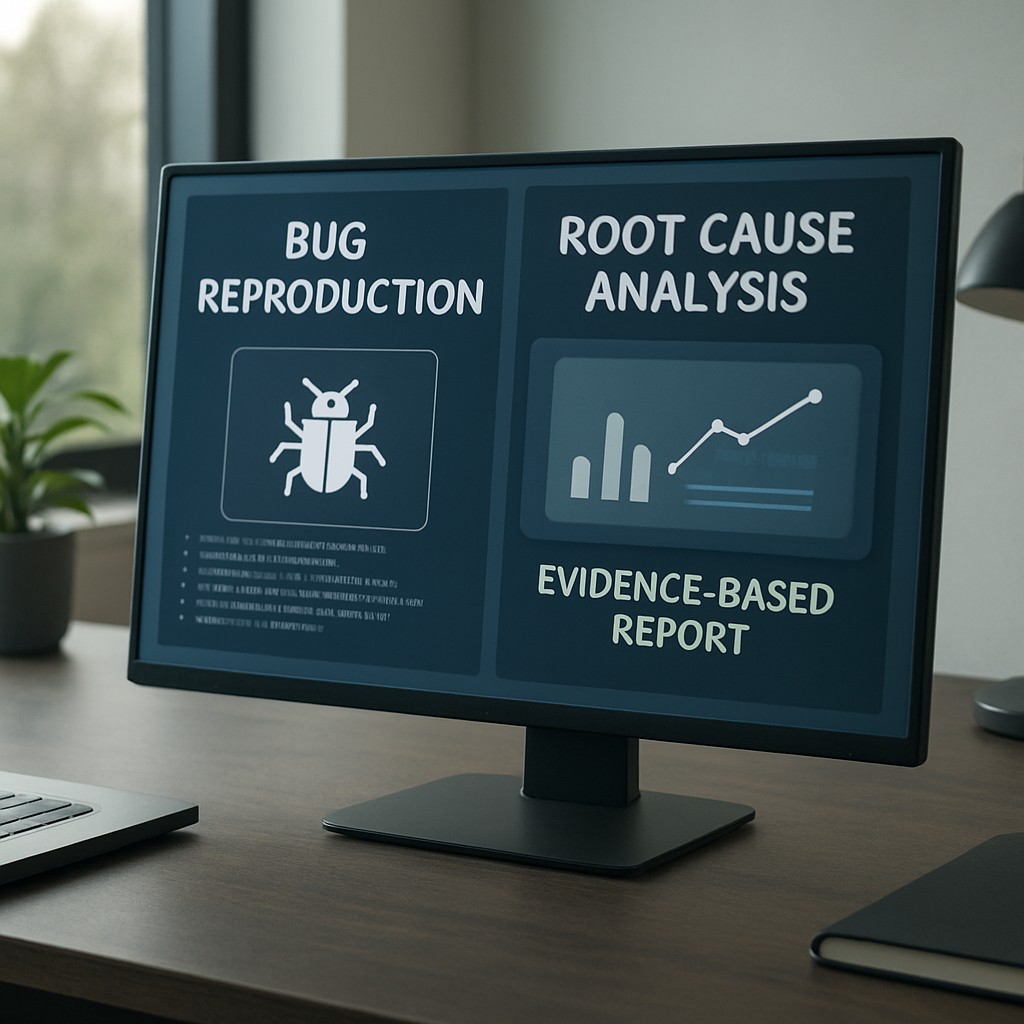
When AI coding assistants suggest a quick “fix,” teams often face two limitations: acceptance may hide the real cause, and rejection may stall the investigation. Osloq addresses this gap by shifting the workflow from “fixing” to proving. Instead of merely reading code and guessing, the agent focuses on finding the conditions that reproduce the bug and returning a report that includes concrete evidence such as logs, call stacks, and screenshots.
What Osloq Is and Why It Matters for Debugging
Osloq is positioned as an AI agent for bug investigation. The central idea is to treat every issue like a mystery that requires verification, not prediction. A typical workflow begins with a user-provided report (for example, a GitHub issue), followed by code tracing, sandbox execution, reproduction attempts, and a structured summary.
The difference from standard AI “repair” suggestions is important for reliability. Debugging is not only about reaching a state where the symptom disappears. It is about ensuring the explanation is correct, the fix is scoped, and side effects are understood.
The Evidence-Based Bug Investigation Flow
Osloq’s approach can be understood as a loop that converts an issue statement into a reproducible experiment.
- 1) Parse the issue: Extract the symptom and environment details from the bug report text. If the issue includes screenshots or error messages, those become part of the context.
- 2) Trace the code path: Identify the likely entry points (handlers, services, event listeners, and data flow). The goal is to map the symptom to specific sections of code that could cause it.
- 3) Reproduce in a sandbox: Run a controlled reproduction attempt. This is where “reading and guessing” is replaced by “running and observing.”
- 4) Capture proof: Collect logs, screenshots, and call stacks. Evidence reduces ambiguity and makes the next debugging step faster.
- 5) Report root cause with explanation: Provide a clear conclusion that ties the observed behavior back to the code and the platform condition.
Illustrative Example: UI Event Handling Differences
A common pattern in debugging is that a bug appears only on certain platforms or browser versions. Consider a scenario such as: “A submit button does not work on Safari.” Instead of offering an immediate code change, Osloq would follow the evidence chain.
It would trace the workflow from the UI interaction to the event handler. Then it would attempt reproduction in a sandbox that mimics the failing environment. If the investigation shows that the expected event does not fire or does not behave the same way across platforms, the report can recommend the correct event model.
Example conclusion (conceptual): The system may observe that the code listens for click but the platform requires an alternative such as pointerdown due to different event bubbling or event dispatch behavior.
This style of reasoning matters because it explains why the symptom occurs and what evidence supports the claim.
How Evidence-Based Reproduction Improves Fix Confidence
AI-driven “fix” suggestions can be risky when acceptance triggers regressions elsewhere. Osloq’s reproduction-first method helps mitigate that risk by clarifying the real failure conditions.
Key benefits
- Reduced guesswork: The agent aims to prove the root cause by observing the bug behavior during execution.
- Better scoping: A specific condition such as “Safari on iOS” can be tied to the fix, lowering the chance of unrelated changes.
- Faster verification: Captured evidence makes it easier for engineers to validate and review the proposed correction.
- More actionable reports: Instead of “change X,” the report emphasizes “the bug reproduces under condition Y because of mechanism Z.”
What to Provide for Strong Reproduction Results
For best outcomes, a bug report should include enough context to allow a reproduction attempt. A reproduction-oriented AI agent generally performs better when the input includes the failure mode, the execution context, and examples of the incorrect output or error.
Useful details include:
- Media type: The bug concerns text, image, audio, or video outputs.
- API or endpoint: The route used (for example, a specific text or image generation endpoint or a chat completion endpoint).
- Prompt and parameters: Any prompt content plus relevant settings such as resolution, seed, quality, safety mode, or model name.
- Observed symptom: Error messages, error codes, screenshots, or output samples showing what went wrong.
- Frequency and environment: How often it occurs and what conditions correlate with the failure.
- Repro consistency: Whether the bug reproduces reliably or only under specific timing or input patterns.
Conclusion
Osloq represents a shift from “AI fixes bugs” to “AI proves what causes the bug.” By tracing code paths, reproducing failures in controlled environments, and delivering evidence-based reports, it helps teams move from uncertainty to verification. For debugging workflows that need reliability, scoping, and reviewable proof, a reproduction-first agent approach offers a practical advantage over suggestion-only tooling.
Leave a Reply