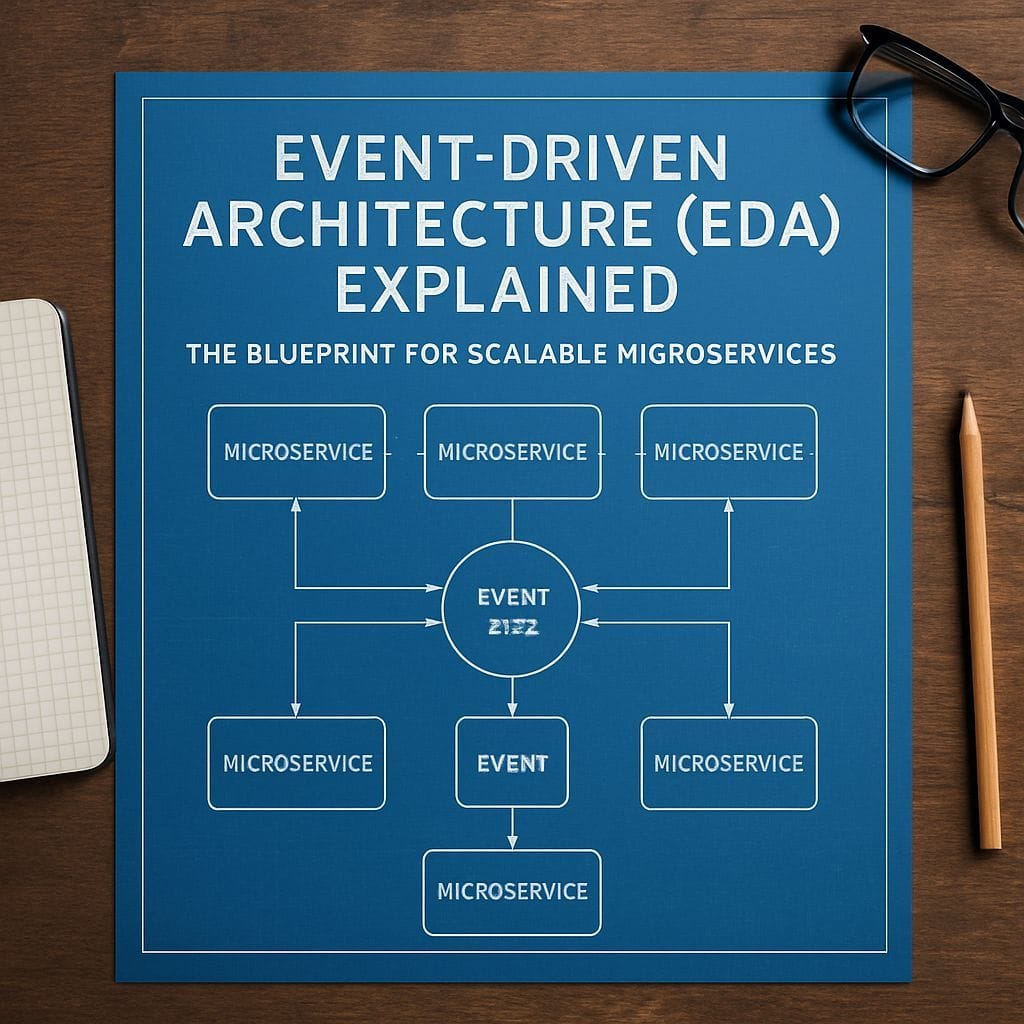
In the landscape of modern software development, the demand for real-time responsiveness and extreme scalability has never been higher. As we navigate 2026, Event-Driven Architecture (EDA) stands as the dominant design pattern for building decoupled, resilient, and agile systems. Unlike traditional monolithic structures that rely on direct commands, EDA introduces a reactive approach where systems communicate through significant occurrences known as events.
What Is Event-Driven Architecture?
At its core, Event-Driven Architecture is a software design pattern where decoupled applications can asynchronously publish and subscribe to events via an event broker. An event is simply a record that something significant has happened within the system. This could be a user placing an order, a temperature sensor detecting a change, or a video stream being paused.
This architecture is designed to reverse the traditional dependency chain. Instead of Service A telling Service B to do something (a command), Service A simply announces that it has finished a task. Service B, which is listening for that announcement, reacts accordingly. This shift from imperative to reactive programming is what makes EDA so powerful.
Why Do We Need EDA?
To understand the necessity of EDA, one must look at the limitations of traditional request-response models (often using HTTP/REST). In a synchronous request-response model, services are tightly coupled. If the Order Service needs to update the Inventory Service, it must make a direct call and wait for a response. As systems grow, these point-to-point connections create a messy web of dependencies.
- Scalability Issues: If one service is slow, it blocks the caller, creating a bottleneck.
- Fragility: Updating one service might break the interface required by another.
- Complexity: Managing hundreds of direct connections becomes a logistical nightmare.
EDA solves these problems by decoupling services. Producers and consumers do not need to know about each other’s existence, allowing teams to scale, update, and deploy services independently.
The Core Components of EDA
A robust event-driven system relies on four primary components working in harmony:
- Event Producer: The source that detects or causes the event. For example, a checkout service that generates an ‘Order Placed’ event.
- Event Consumer: The service that listens for events and reacts to them. An inventory service might consume the ‘Order Placed’ event to deduct stock.
- Event Broker: The middleware (like Apache Kafka or RabbitMQ) that acts as the intermediary. It receives events from producers and routes them to the appropriate consumers.
- Event Contract: The agreed-upon format of the event data, ensuring that consumers can parse the message correctly.
Real-World Applications
EDA is the engine behind many of the platforms used daily. Streaming giants use it to track user interactions in real-time. When you pause a movie, an event is fired. This event might trigger analytics, update your watch history, and adjust recommendations simultaneously. Similarly, ride-sharing applications use events to calculate ETA, match drivers, and implement surge pricing based on real-time demand and traffic data.
EDA vs. Service Mesh
It is crucial to distinguish between EDA and Service Mesh, as both are popular in microservices:
- EDA focuses on asynchronous, event-based communication for business logic and state changes.
- Service Mesh handles synchronous, service-to-service communication, focusing on network management, security, and observability.
In 2026, sophisticated architectures often utilize both: Service Mesh for direct queries and EDA for state propagation and business workflows.
Types of Event Processing
Not all event handling is the same. It generally falls into two categories:
1. Simple Event Processing
This involves a direct cause-and-effect relationship. An event occurs, and a downstream action is triggered immediately. For instance, a user updates their email address, and the database saves the change.
2. Complex Event Processing (CEP)
This involves analyzing a series of events to derive a conclusion. A single credit card transaction might be normal, but five transactions in one minute from different countries triggers a fraud alert. CEP looks for patterns over time across multiple data streams.
Benefits and Challenges
Benefits:
- Fault Tolerance: If a consumer goes offline, events are queued in the broker and processed when the service returns, preventing data loss.
- Independent Scaling: You can scale the consumer service independently if a specific event type experiences a spike in traffic.
- Agility: New features can be added by simply plugging in a new consumer to listen to existing events without modifying the producer.
Challenges:
- Eventual Consistency: Data may not be consistent across all services immediately. Systems must be designed to handle this delay.
- Debugging Difficulty: Tracing the path of a transaction through multiple decoupled services is harder than tracing a linear HTTP request.
- Ordering: Ensuring events are processed in the exact order they occurred requires careful architectural planning.
Final Thoughts
Event-Driven Architecture is not merely a trend; it is the fundamental standard for building large-scale, responsive systems. By decoupling services and enabling real-time data processing, EDA allows organizations to innovate faster and handle the massive data loads characteristic of the digital age.
Leave a Reply