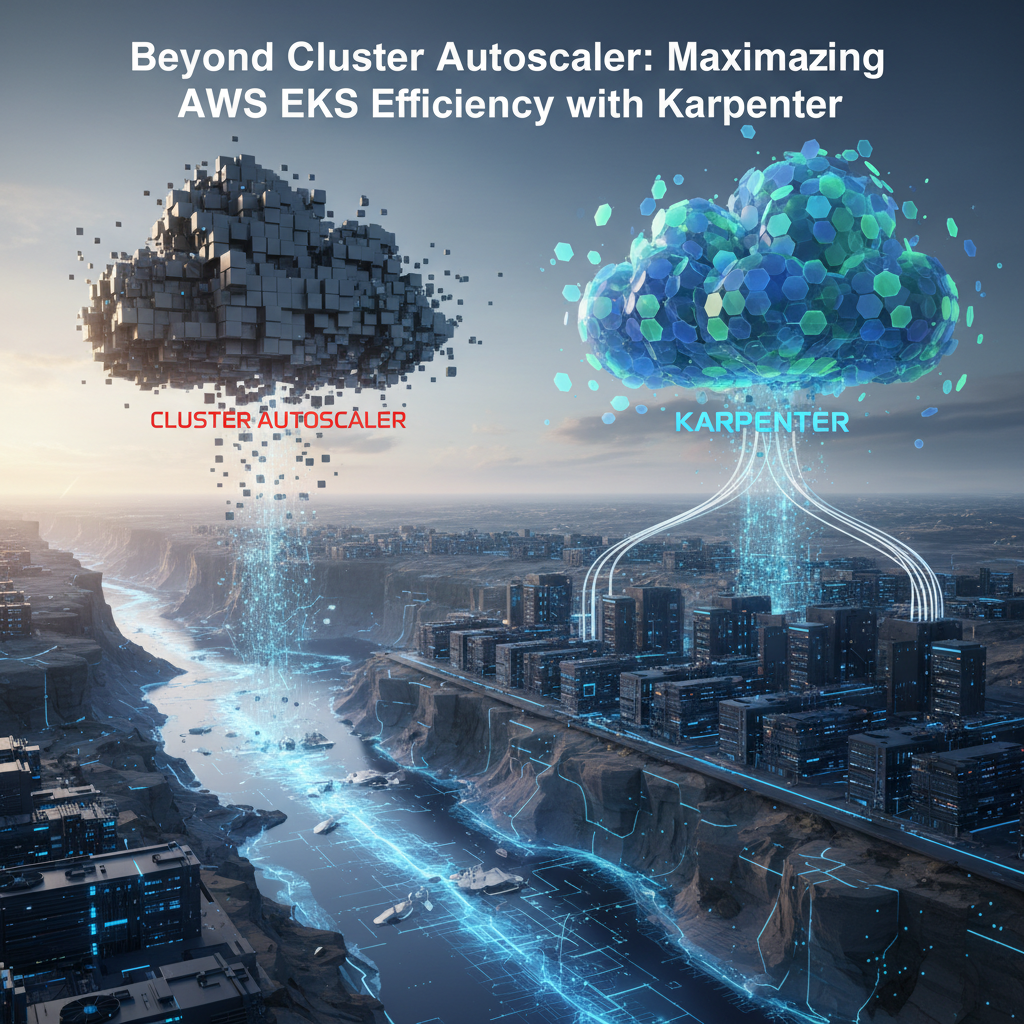
Managing production Amazon Elastic Kubernetes Service (EKS) clusters historically required a tedious balancing act. Platform teams had to estimate peak loads, size node groups with generous buffers to prevent scheduling failures, and accept the high financial cost of underutilized infrastructure. Traditional Kubernetes autoscaling, while functional, relies on forecasting models that struggle to adapt to dynamic, real-time workload demands.
The Limitations of Traditional Cluster Autoscaling
For years, autoscaling on EKS relied on the Kubernetes Cluster Autoscaler (CA) paired with AWS Auto Scaling Groups (ASGs). This model operates through a rigid loop. When pods enter a pending state due to insufficient resources, the Cluster Autoscaler simulates whether adding a node to an existing ASG would resolve the scheduling failure. If the simulation succeeds, it triggers the ASG to scale up.
However, this design introduces significant inefficiencies:
- Predefined Node Shapes: Cluster Autoscaler cannot dynamically design a node. It can only scale pre-existing node groups. If a workload requires a unique combination of CPU and memory, the autoscaler may provision an oversized instance, leaving massive amounts of compute resources idle.
- Homogeneity Requirements: To ensure accurate simulations, Cluster Autoscaler requires all instances within an ASG to be identical. Mixing instance types, purchase options (Spot vs. On-Demand), or availability zones requires creating separate node groups for every single permutation. This results in complex management matrices that are difficult to maintain.
- Slower Scaling Times: Because the Cluster Autoscaler must communicate through ASGs and wait for scaling policies to execute, provisioning a new node typically takes three to five minutes.
The core limitation of the traditional model is that instance decisions must be made at configuration-authoring time, when the least is known about future workloads, rather than at runtime when actual demand signals arrive.
Enter Karpenter: Workload-Centric Autoscaling
Karpenter, an open-source, high-performance node provisioner developed by AWS, bypasses the limitations of Auto Scaling Groups entirely. Instead of managing static node groups, Karpenter takes a workload-centric approach by communicating directly with the AWS EC2 API.
How Karpenter Operates at the API Level
Karpenter monitors the Kubernetes API server for unschedulable pods. When a scheduling failure occurs, Karpenter evaluates the precise resource requests, node selectors, affinities, and tolerations of the pending pods. It then immediately provisions the optimal EC2 instance type and size to fit those exact requirements, launching the new node in approximately 45 to 90 seconds.
Core Architecture: NodePools and EC2NodeClasses
Karpenter simplifies infrastructure management by replacing dozens of customized node groups with two primary Custom Resource Definitions (CRDs):
- NodePool: This provider-agnostic resource defines the logical constraints for the nodes Karpenter can provision. It configures allowed instance families, availability zones, capacity types (such as Spot or On-Demand), taints, and node expiration parameters.
- EC2NodeClass: This AWS-specific resource dictates how Karpenter interacts with AWS to launch instances. It configures the underlying infrastructure details, including Amazon Machine Images (AMIs), security groups, subnets, and IAM roles.
Active Workload Consolidation and Cost Optimization
Beyond rapid scaling, Karpenter continuously optimizes cluster efficiency through a process called consolidation. Karpenter actively monitors the cluster for underutilized or expensive nodes. If it identifies an opportunity to reschedule pods onto fewer, more cost-effective instances, it automatically provisions the new instances, migrates the workloads, and terminates the redundant, expensive nodes. This continuous bin-packing capability can reduce overall compute costs by 20% to 60% while eliminating the manual overhead of managing complex node group matrices.
Leave a Reply