Key Reliability Criteria
When shipping labels must survive network glitches, printer stalls, or burst traffic, the foundation is a reliability gate that does not depend on the renderer. Four invariants should govern every rendering job:
- Idempotent job identity – each request is assigned a unique key that survives retries.
- Immutable byte record – the final PDF bytes are stored with a cryptographic digest for audit.
- Merge‑split traceability – parent–child relationships and rules that generated a bundle are logged.
- No silent state change on timeout – a request that times out must remain in a pending state until a definitive result is obtained.
These rules apply whether the rendering happens on a cloud service or within a local process. The decision point is the failure surface that an organization can monitor and manage.
Hosted PDF APIs vs. Local Libraries
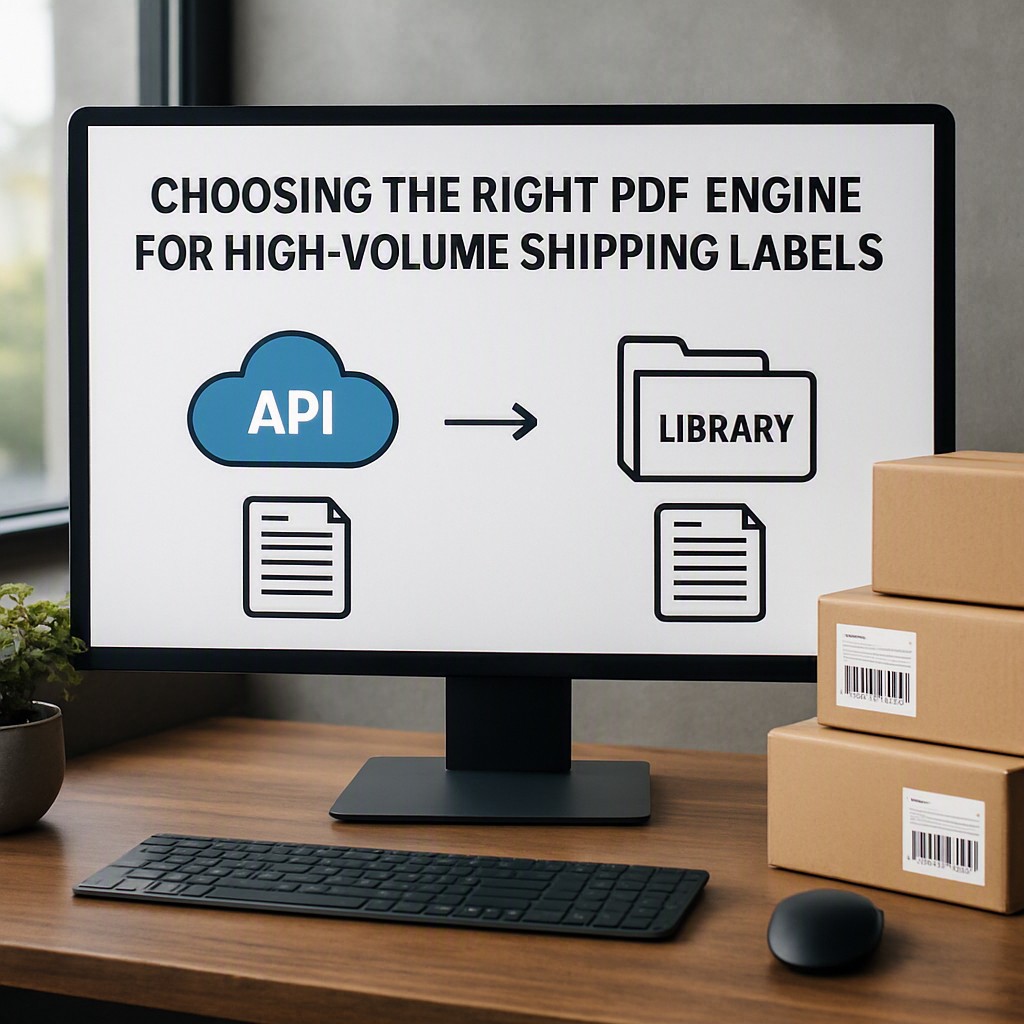
A hosted API removes DNS lookups, connection setup, and the need for font management from the application stack. It introduces an extra hop that can become the bottleneck when concurrent bursts exceed the provider’s queue limits. A local library eliminates the network hop but exposes the application to font dependencies, memory constraints, and the cost of maintaining an environment that scales with traffic.
Choosing between the two requires objective data. The recommended approach is to run a p95 / p99 measurement under identical loads, then verify that the byte streams are byte‑for‑byte identical and traceable to the originating request.
Performance Under Load
Typical metrics to collect are: queue wait time, rendering duration, and transfer time. For an API, the queue wait may be negligible at low concurrency but can spike at the 99th percentile during peak periods. For a local library, CPU saturation or font‑cache misses often cause worker queues to outpace printer pickup windows, creating a tail of delayed labels.
Building a Robust Test Harness
Create a test corpus that stresses every edge case: longest street address, non‑ASCII characters, all supported label sizes, empty optional fields, large barcodes, and the maximum merge/split bundle. Use identical template revisions and input data for each rendering engine. Warm‑up runs should be excluded from the final data set to avoid caching effects.
“When the application cannot determine if a timed‑out request completed on the server side, blind retries may duplicate label artifacts.” – Source: Shipping Label Reliability Study, 2026.
Practical Vendor Landscape (2026)
The market offers a range of managed APIs that handle scaling and compliance:
- CraftMyPDF – visual editor, high throughput, and API integration.
- PDF.co – extensive format support, including barcode generation.
- PDF Generator API – ISO 27001:2022 certified, suitable for regulated industries.
- PDFBolt – 99.9% uptime, GDPR compliant, and template editing via Handlebars.
For organizations that require full data control, self‑hosted alternatives such as Nutrient or Document Engine remain viable, provided that the team has the capacity to patch, scale, and secure the environment.
Cost vs. Control Considerations
Managed APIs typically charge per document, ranging from $0.01 to $0.08 in 2026, depending on volume. Local libraries incur infrastructure costs (CPU, memory, storage) but eliminate per‑render fees. The trade‑off becomes evident when evaluating the cost of a single failed label versus the ongoing operational overhead of maintaining a rendering cluster.
Conclusion
Adopting a reliability gate that treats rendering as an external service, regardless of whether it is hosted or local, ensures consistent auditability and fault isolation. By measuring tail latencies, verifying byte integrity, and understanding the cost and compliance profile of available vendors, a logistics system can confidently scale label generation without compromising on reliability or governance.
Leave a Reply