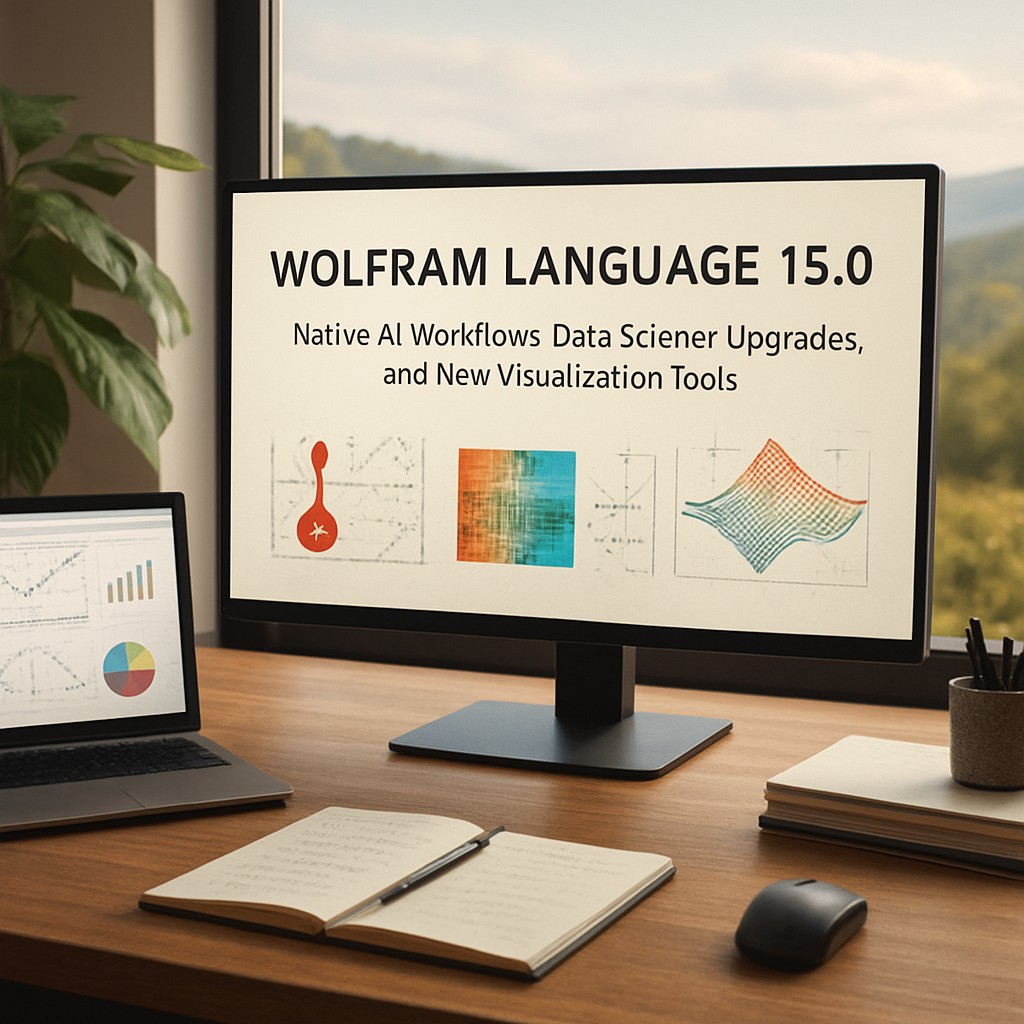
Wolfram Language 15.0 represents the latest major step in a computational language designed to be usable by both people and AI agents. As the language underpinning Mathematica, Wolfram Language focuses on making complex computation, mathematics, and data work flows accessible through a unified system of built-in capabilities. The standout theme of this release is how AI features are integrated directly into the day-to-day workflow, rather than treated as a separate add-on.
What Wolfram Language 15.0 changes at a glance
Wolfram Language 15.0 builds on the core idea that computation should be expressible, repeatable, and readable. The practical impact of the 15.0 release is concentrated in four areas:
- Native AI integration that supports common development and analysis steps inside the language environment.
- Data science and mathematics enhancements across key algorithms and data transformations.
- Improved visualization and graphics capabilities to accelerate exploration and communication of results.
- User interface refinements that improve usability and accessibility for interactive work.
Native AI integration: AI as part of the workflow
Version 15.0 emphasizes AI being woven into the language and interface. Instead of relying entirely on external services or standalone prompts, the goal is to make AI assistance feel like a native component of computational work.
For users with active licenses, Wolfram describes integrated AI assistance as available at no additional cost within the environment. This positioning matters because it changes how teams may plan workflows: AI becomes a tool for accelerating reasoning, drafting code patterns, and supporting iterative analysis while staying close to the language’s own structure.
Why “native” integration matters
- Faster iteration: AI assistance is available where work happens, reducing context switching.
- Consistency: results and suggestions can align with language conventions and built-in capabilities.
- Workflow continuity: AI support is not isolated from computation and visualization.
Data science and mathematics enhancements in Version 15.0
Wolfram Language 15.0 includes meaningful improvements for data science and mathematical computation. The release highlights upgrades across several areas, including time series analysis and tabular data workflows.
Key areas that benefit
- Time series analysis: improved functionality for examining trends, seasonality, and related patterns that appear in sequential data.
- Tabular data workflows: enhancements for transforming, cleaning, and operating on structured datasets.
- Core mathematical algorithms: refinements intended to improve performance and capability across fundamental computations.
- Data science productivity: expanded tooling to make end-to-end analysis more direct.
For many teams, the practical value of these improvements is reduced friction in moving from raw data to validated results. When time series and tabular workflows become smoother, users can spend more time on interpretation and less time on plumbing.
Visualization and interface improvements
Version 15.0 also focuses on better ways to plot, visualize, and interact. The release includes new or enhanced plotting and graphics capabilities, which supports deeper exploration during analysis.
Interactive UI upgrades
Beyond plotting, Wolfram Language 15.0 includes user interface refinements designed to improve the interactive experience. One example described in the release notes is a floating footer cell plus adjustments toward more accessible layouts.
How it fits into the version history
Wolfram Language has followed a steady cadence of improvements over time. Earlier major versions established a foundation for incremental upgrades, and Wolfram Language 15.0 now extends those capabilities with the most visible “AI-native” direction.
Reference context for the timeline of the language’s releases:
- 14.0 (January 2024)
- 14.1 (July 2024)
- 14.2 (January 2025)
- 14.3 (August 2025)
- 15.0 (June 2026)
Where to find official details
For readers who need precise change logs, the following resources are designed to map directly to the features introduced in the release:
- Wolfram Language Quick Revision History
- Wolfram Documentation Center: search for “New in Version 15”
- Wolfram U materials and webinars covering “New in Wolfram Language and Mathematica 15”
Bottom line
Wolfram Language 15.0 strengthens the connection between computation, data science, and AI by making AI assistance a native part of the workflow. Combined with advances in mathematical algorithms, data-focused features, and improved visualization plus interface usability, the release is positioned as a practical upgrade for researchers, analysts, and developers who build with the Wolfram ecosystem.
Best-fit use cases: teams that use Mathematica or Wolfram Language for analysis, time series work, structured data processing, and interactive exploration, and those looking for AI support integrated into the language environment.
Leave a Reply