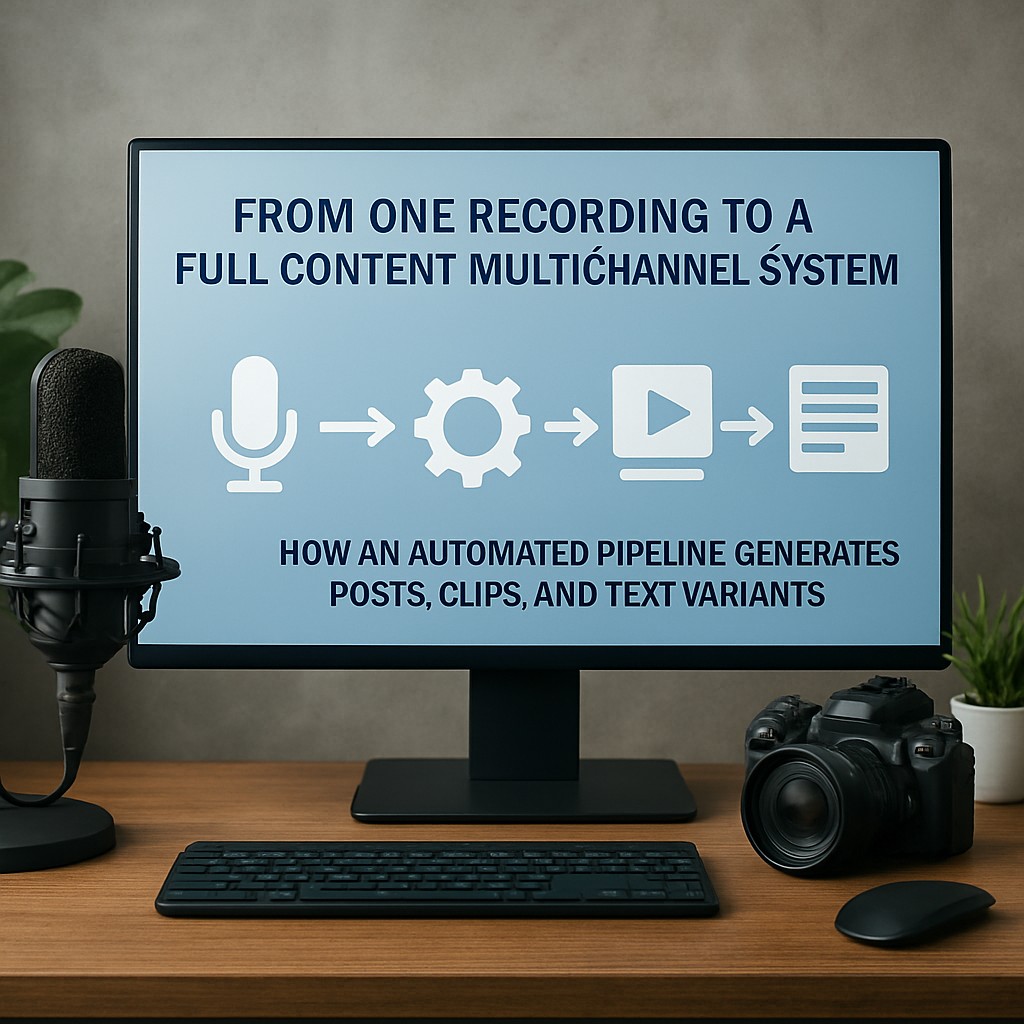
A content engine that turns a single recorded video into a complete, multi-platform publishing package addresses a common bottleneck: not content creation, but content repurposing. The key idea is to automate the repetitive steps that normally drain time and slow down distribution. When the system records once, it can automatically extract clips, transcribe and caption them, apply music, and publish across major social and professional platforms. It can also convert the same recording into text assets like blog drafts, social threads, quote cards, caption alternatives, and audience-specific versions.
The real bottleneck is distribution work, not filming
Many creators can capture a strong recording in minutes. The time cost usually shows up later, during mechanical tasks such as:
- Cutting the best moments from a longer video
- Transcribing and generating readable captions
- Formatting content for each platform’s expectations
- Posting to multiple channels and maintaining consistency
- Creating secondary assets from the same source
An effective pipeline treats those tasks as an assembly line. Instead of manually editing and reformatting five different versions, the system produces platform-ready outputs through modular automation.
How the pipeline works: from recording to a publishing package
The pipeline can be visualized as a sequence of stages, with an additional “human approval” gate to prevent accidental publishing mistakes. A typical flow looks like this:
- Record (1 to 10 minutes): The source video is captured once.
- Upload to a cloud folder: The video is placed in a shared drive location such as Drive or Dropbox to trigger downstream steps.
- Auto-clip: The system selects high-signal moments and generates vertical clip versions.
- Transcription and subtitles: Captions are created per platform requirements, using the transcript as the ground truth.
- Virality scoring: Each clip can receive a score so the “best moments” are prioritized for publishing.
- Auto-music: A mood-matched royalty-free music bed is layered under the voice track.
- Caption + host: Media is assembled with captions and uploaded using a multi-platform posting mechanism.
- Stage and approve: A staging step ensures humans can review before anything goes live.
- Distribute: The final assets are published to platforms such as TikTok, Instagram, YouTube, Facebook, and LinkedIn.
- Multiply (text): The same recording is turned into a blog draft, social threads, caption variations, quote cards, and even an ebook outline.
- Adapt (audience): Content can be re-expressed at different reading levels or tailored for different audience segments.
Adoption strategy: The system can be implemented in lanes. Video-first automation can run first, while text generation or audience adaptation can be added later without rewriting the entire pipeline.
Modular components and practical tools
A strong engine uses swappable modules so each part can evolve independently. For example, one can replace a transcription provider or a posting service without breaking the full workflow.
Common module choices
- Clipping + transcription: Vizard API can take a cloud video URL and return scored vertical clips along with a transcript.
- Music mixing: ffmpeg is used to combine a music bed with the voice track. Ducking and mixing controls help ensure the voice remains clear.
- Hosting + multi-platform posting: A service like PostPeer can support a “post once” style workflow, with presigned uploads for media.
- Orchestration: A small Python service can coordinate steps, or an automation platform such as n8n can be used.
- Text and asset generation: Any LLM can transform transcripts into blog content, threads, captions, and structured summaries.
- Runtime: A low-cost Linux VPS with a process manager like pm2 can host the pipeline reliably.
Music ducking: keeping clarity under the beat
Music ducking is a common requirement. The system can apply a sidechain-style behavior so the music level lowers when speech occurs, improving intelligibility without manual audio editing.
Publishing controls that reduce risk
Automation should not remove quality control. A staging step where humans approve staged assets is a practical safeguard. This also enables quick corrections to:
- Caption wording and punctuation
- Clip selection accuracy
- Brand tone and formatting
- Platform-specific constraints
With approval in place, automation accelerates the mechanical work while keeping editorial oversight.
Optional integrations for richer asset generation
Beyond text and standard video edits, some systems expand to generate images, thumbnails, or additional media variants. If Pollinations is used for generation, endpoints such as gen.pollinations.ai can produce images, text, audio, or video. A practical use case is generating platform-specific thumbnails or caption variants derived from the transcript.
Benefits of a one-video-to-many-output approach
A content engine that multiplies outputs from a single recording typically improves:
- Consistency: Multiple platforms receive aligned messaging from the same source.
- Efficiency: Editing and repackaging work is reduced from hours to minutes.
- Scale: Text assets and clip assets can be refreshed regularly without re-recording.
- Adaptability: Audience-specific rewording supports different segments without duplicating effort.
Conclusion
Turning a single recording into a complete multichannel content system becomes achievable by automating the mechanical steps: auto-clipping, transcription and captioning, music mixing, staging, multi-platform distribution, and text asset generation. When built as modular components behind thin wrappers, the pipeline stays maintainable and extensible, enabling incremental adoption and ongoing improvement.
Leave a Reply