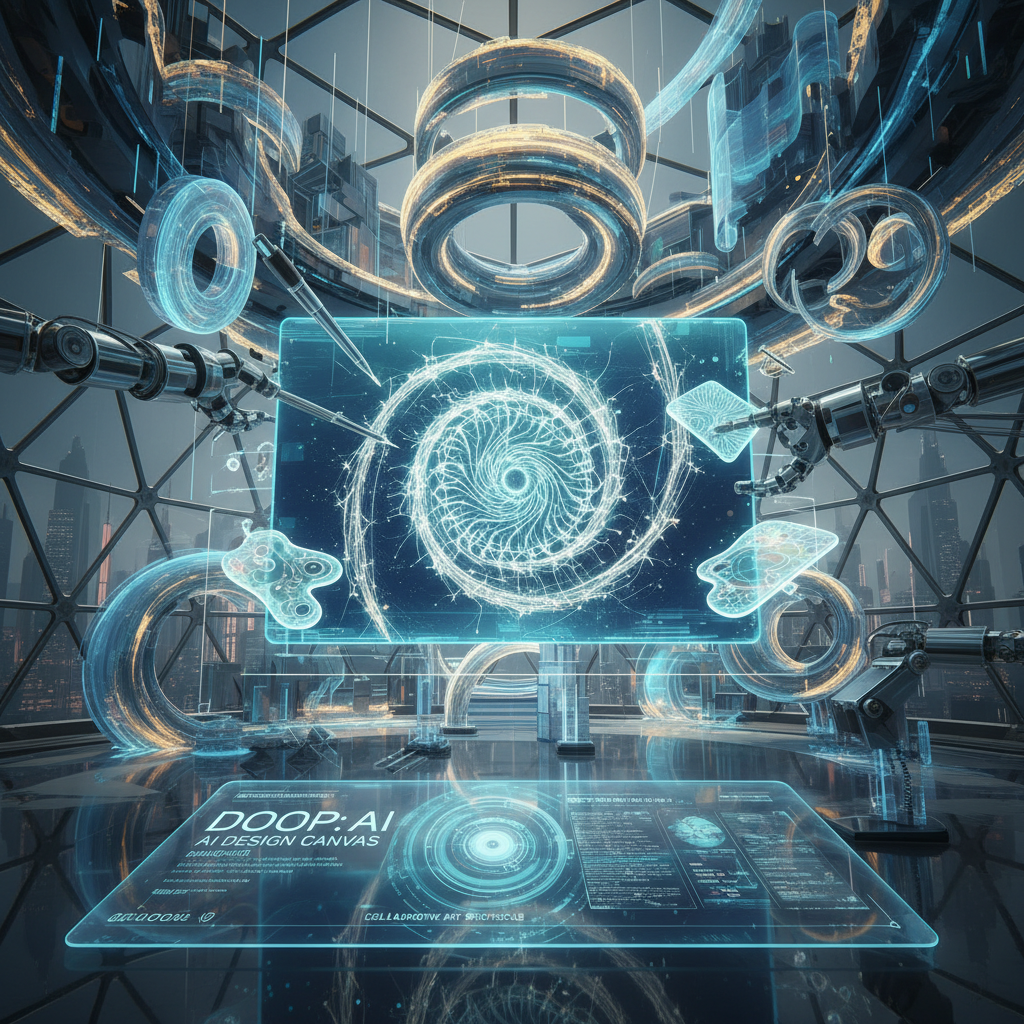
Doop Unveiled: The AI Design Canvas Revolutionizing Collaborative Art
In 2026 a new AI design platform emerged, positioning itself as a shared creative playground where multiple artificial agents and human users draw on a single canvas in real time. The tool, called Doop, offers a limitless multiplayer space that integrates well‑known AI models such as Claude and Codex, allowing them to stream designs, critique each other’s work, and maintain a collective memory of every design decision.
How Doop Works
Doop’s architecture is built around a continuous, open‑source framework that can be extended by users. Each AI agent can be assigned a role—designer, reviewer, or curator—and communicates via a lightweight message protocol. When an agent proposes a visual element, it is instantly rendered on the canvas, visible to all participants. Other agents can then suggest refinements, annotate the work, or flag potential issues. This live feedback loop removes the bottleneck of traditional design workflows where iteration often requires separate files and lengthy review cycles.
Users can also attach their own AI subscriptions, meaning that a single Doop session may host a mix of open‑source models, proprietary APIs, and community‑contributed plugins. The platform’s memory system ensures that every change is logged, making it possible to trace the evolution of a design and revert to earlier states if needed. This traceability is especially valuable in collaborative environments such as advertising agencies, game studios, and product design firms.
Key Features
- Infinite Canvas: No page limits allow for sprawling layouts, storyboards, or concept maps.
- Live Agent Collaboration: AI agents act as real‑time co‑designers, generating ideas, textures, or entire layouts based on prompts.
- Shared Contextual Memory: All participants share a unified history of design decisions, ensuring consistency across iterations.
- Open‑Source Flexibility: Developers can extend Doop with custom agents or integrate additional AI services.
- Cross‑Platform Access: Web‑based interface means designers can join from any device.
Beyond Design: The Many Faces of “Doop”
While Doop’s primary focus is AI‑driven design collaboration, the name has a rich cultural footprint that spans music, religion, comics, social media, and sports.
- Music: A Dutch electronic duo popularized the term with a 1994 hit that blended Charleston rhythms with big‑band samples.
- Religion: In Dutch, the word means baptism, a sacramental rite historically recorded in baptism books.
- Comics: A quirky green mutant character debuted in 1999, recently gaining renewed interest through upcoming series.
- Social Media: On TikTok, “doop” is slang for a cheaper duplicate of a designer product.
- Sports: Philadelphia Union fans chant “doop” as a celebratory refrain when the team scores.
“Doop is more than a tool; it is a new way of thinking about creative teamwork,” says a design industry analyst.
Impact on the Creative Industry
By collapsing the traditional divide between human intent and AI execution, Doop promises to accelerate project timelines, democratize access to high‑quality design resources, and foster cross‑disciplinary collaboration. Early adopters in branding agencies report up to a 30 percent reduction in revision cycles, while educational institutions are exploring Doop as a teaching aid for design fundamentals.
Because the platform is open source, community contributions can rapidly introduce new features such as advanced generative models, specialized art styles, or domain‑specific toolkits. This modularity ensures that Doop can evolve with emerging AI capabilities, maintaining its relevance in a fast‑moving field.
In summary, Doop’s live, multiplayer canvas represents a significant step forward for collaborative design. By blending AI agents, shared memory, and an infinite workspace, it enables teams to iterate faster, stay aligned, and push creative boundaries.
Leave a Reply