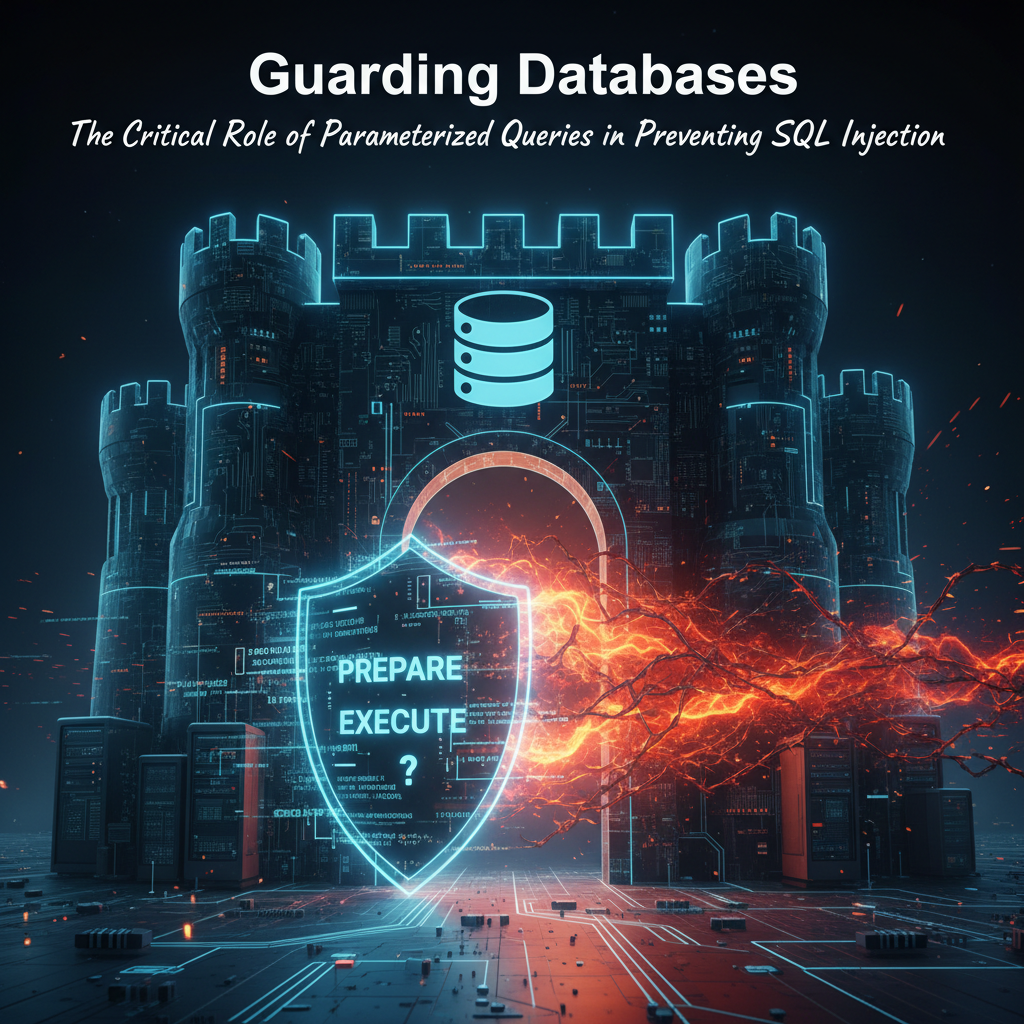
SQL injection remains a persistent threat whenever an application mixes user input directly into a database query. The root problem is that the application treats input as executable code rather than data. By separating the two, developers can enforce a strict boundary between SQL logic and user-supplied values. Parameterized queries are the primary tool for establishing this boundary and are widely regarded as a foundational security practice across all major database systems.
Unsafe Query Construction
When developers build queries by concatenating strings, a malicious user can inject SQL that alters the intended operation. For example, a page that accepts a project name may construct a query like this: "SELECT * FROM projects WHERE name = '" + userInput + "'". If the input contains characters such as '; DROP TABLE users; --, the resulting statement may execute destructive commands instead of a safe lookup.
Why the Danger Persists
Attackers exploit the fact that database engines interpret any embedded SQL syntax as executable commands. The application loses control over the statement structure, and the database may treat injected text as code. This breaks the security boundary that must keep user data separate from query logic. Validation alone, while necessary, cannot guarantee that a malicious string will not be interpreted as code.
Parameterization: Separating Code from Data
Using parameterized queries, the application sends the SQL text and the data separately. For instance: db.query("SELECT * FROM projects WHERE name = ?", [userInput]);. The driver replaces the placeholder with a properly escaped value, ensuring that the database engine never executes it as code. This approach is supported across languages such as Java, Python, PHP, Node.js, and C#.
Key Benefit: Parameters are treated strictly as data, preventing accidental or malicious execution of injected SQL.
Real-World Example with Validation
A page that retrieves projects by numeric ID illustrates how validation and parameterization work together:
- Validate that the ID is a positive integer:
if (!Number.isInteger(id) || id <= 0) throw new Error("Invalid ID"); - Query using a parameter:
db.query("SELECT * FROM projects WHERE id = ?", [id]);
This dual strategy ensures that only legitimate values reach the database, while any tampering is blocked before the query is formed.
Beyond Security: Performance and Maintainability
Parameterized queries also bring performance advantages. When a query contains placeholders, the database can cache the execution plan and reuse it for subsequent calls, reducing compilation overhead. Additionally, separating SQL logic from data improves code clarity, making reviews and refactoring safer and less error‑prone.
Industry Endorsements and Best Practices
Leading security organizations such as OWASP, NIST, and CISA recommend parameterized queries as the gold standard for preventing SQL injection. Best practices include:
- Use prepared statements in every database interaction involving user data.
- Combine parameterization with strict input validation and output encoding.
- Employ least‑privilege database accounts to limit the impact of any potential breach.
- Conduct regular code reviews and automated scanning for dynamic query patterns.
Conclusion
Parameterized queries are a simple, effective, and widely supported defense against SQL injection. By ensuring that user input can never alter the structure of a SQL command, developers eliminate a major attack vector while also gaining performance and maintainability benefits. Adopting this practice as part of a broader security strategy—paired with validation, least privilege, and thorough code reviews—provides robust protection for modern applications interacting with relational databases.
Leave a Reply