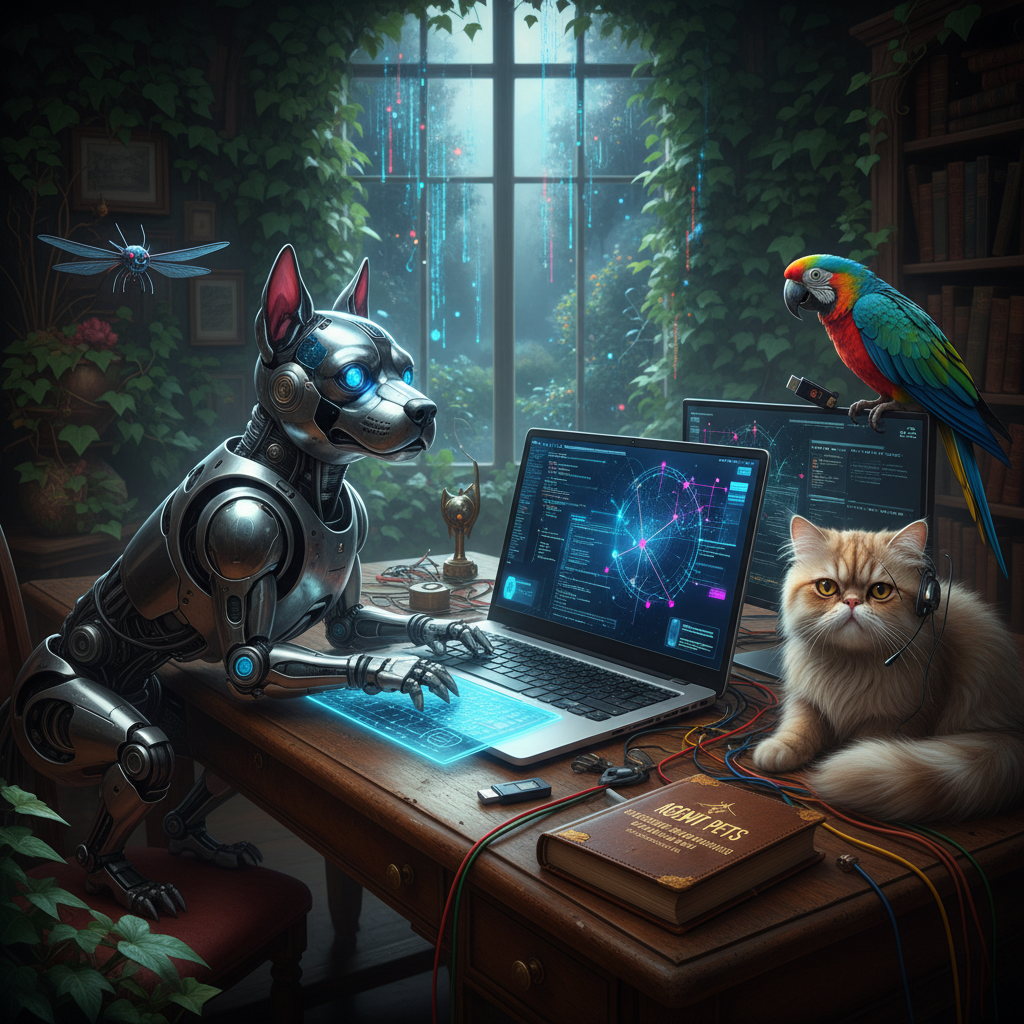
AI Agent Pets: Animating the Developer Experience
In the fast‑moving world of software development, artificial intelligence is increasingly integrated into daily workflows. A new trend that blends creativity and utility is the emergence of animated digital companions, commonly known as Agent Pets. These companions appear as small, lively characters on a developer’s screen, reacting in real time to the state of AI coding tools such as Codex, Claude Code, Cursor, and Gemini CLI.
How Agent Pets Communicate
- When an AI agent is processing a request, a pet may display a thinking face or a spinning icon.
- If the tool requires user input, the pet shows a “Your Turn” gesture.
- Permission prompts, such as “Allow Bash?”, trigger a curious look or a shrug.
- Completion of a task is celebrated with a cheering animation.
These visual cues transform abstract processes into engaging, intuitive signals that reduce cognitive load and make the development environment more approachable.
AgentPets.dev: A One‑Stop Platform
Behind the scenes, the AgentPets.dev platform hosts a catalog of over 216 unique companions. Developers can preview animations, read descriptions, and install a chosen pet with a single command. The library supports a wide range of coding agents, ensuring that every tool can have its own mascot.
“Agent Pets bring a touch of personality to the code editor, turning routine AI interactions into an engaging experience.”
By providing immediate visual feedback, these pets reduce misunderstandings and help teams stay synchronized, especially in collaborative coding sessions.
From Digital Pets to Real‑Life Spies: Animals in Intelligence Operations
The term “Agent Pet” also captures a centuries‑old practice: the deployment of animals by intelligence agencies to gather information, deliver messages, and even sabotage targets. Their natural abilities—stealth, endurance, and unique sensory capabilities—make them invaluable covert assets.
Historical Real‑Life Examples
- Dolphins: Trained by the U.S. Navy and Russia, they locate underwater mines, escort submarines, and retrieve equipment.
- Pigeons: Used since World War I for aerial reconnaissance, equipped with miniature cameras to photograph enemy territory.
- Dogs: Employed as message carriers, explosive detection, and even parachuting into hostile areas during the World Wars.
- Cats: The CIA’s “Acoustic Kitty” program attempted to embed listening devices in cats, a costly and ultimately abandoned experiment.
- Rats and Birds: Gutted rats served as dead drops, while ravens carried transmitters for covert eavesdropping.
Modern and Emerging Applications
Recent reports suggest that agencies are exploring marine mammals such as beluga whales and seals for underwater surveillance, and even robotic insects as drone replacements. These innovations reflect an ongoing quest to leverage natural or engineered creatures in covert operations.
Fictional Animal Agents: A Cultural Reflection
Popular media often exaggerates the spy potential of animals, creating memorable characters that capture the imagination. Examples include:
- “Perry the Platypus” from Phineas and Ferb, a secret agent disguised as a pet.
- Teams of anthropomorphic animals in shows like The Creature Cases, each with special espionage skills.
- Literary and cinematic depictions of cats, dogs, and birds working for clandestine organizations.
These fictional portrayals not only entertain but also highlight society’s fascination with the idea that even the most ordinary creatures can perform extraordinary feats.
Bridging Two Worlds: Lessons and Implications
Both AI Agent Pets and animal spies share a core principle: they serve as intermediaries that translate complex signals into approachable actions. For developers, animated companions reduce friction when interacting with sophisticated AI systems. For intelligence agencies, animals provide discreet, adaptable channels for information flow.
Understanding how visual and biological agents augment human capabilities can inspire cross‑disciplinary innovations. As technology evolves, the line between digital mascots and biological operatives may blur, leading to new hybrid systems that combine the strengths of both worlds.
Leave a Reply