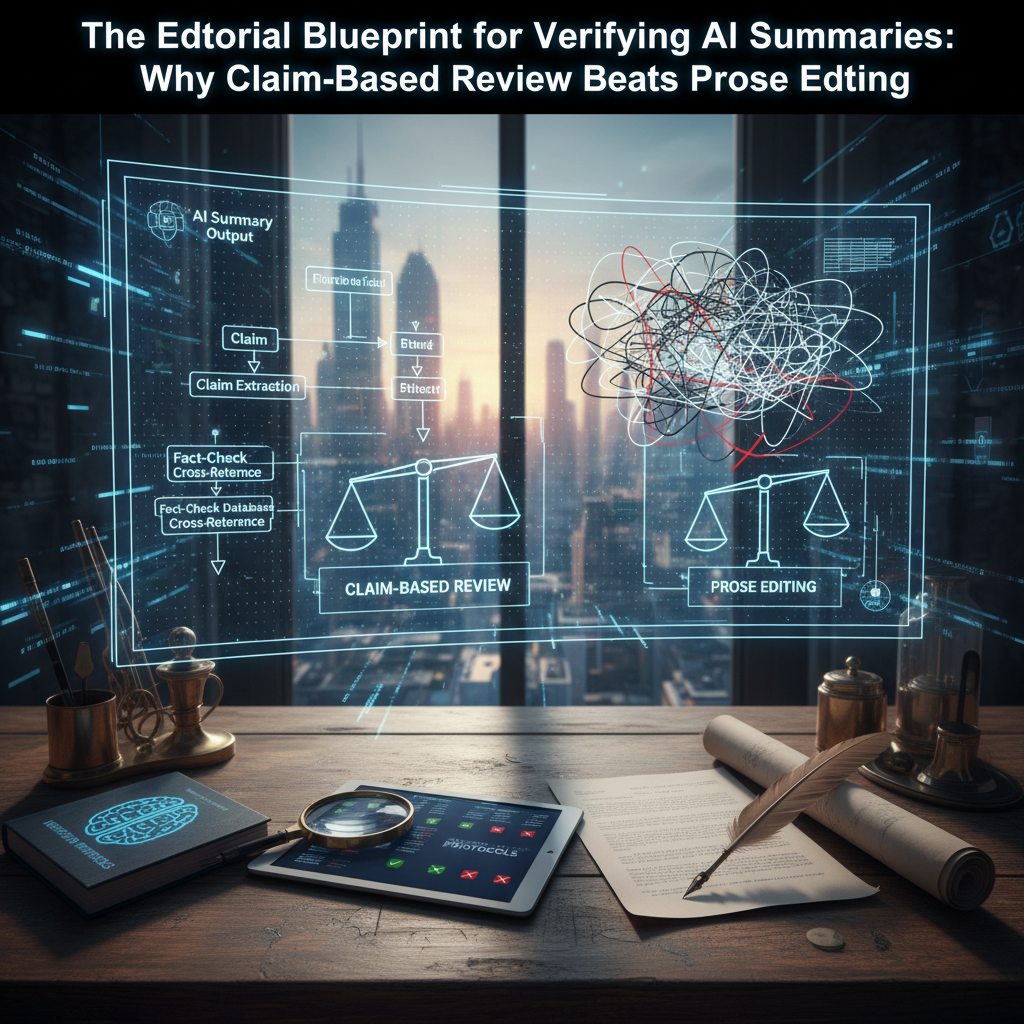
Artificial intelligence has revolutionized content creation, enabling the rapid generation of summaries, newsletters, and technical briefs. However, a significant challenge remains: an AI-generated summary can be highly readable, grammatically flawless, and completely coherent, yet entirely inaccurate. When a product announcement is misconstrued as a proven result, or a planned future rollout is framed as an active feature, standard proofreading fails to catch the error. To maintain editorial integrity, publishers must shift from traditional prose polishing to a rigorous, claim-based verification workflow.
The Illusion of Readability in AI Outputs
AI models are designed to generate fluent language, which often masks underlying factual distortions. A number can easily lose the specific condition that made it meaningful, or an internal company evaluation can be misrepresented as an independent third-party recommendation. Because the writing sounds professional, editors may overlook these subtle shifts. Treating an AI summary as a collection of individual assertions, rather than a cohesive paragraph, allows editors to dissect the text and verify its substance systematically.
Transitioning to a Claim-Based Editorial Workflow
Transitioning to a claim-based review process requires a structured methodology. Instead of editing the final draft immediately, editorial teams should break down the text into verifiable components.
1. Segment the Summary into Individual Claims
Editors should analyze the summary sentence by sentence, isolating each distinct assertion. For example, a sentence stating that a company launched a new product to widespread customer acclaim contains two separate claims: the product launch itself, and the positive customer reception. Each must be verified independently.
2. Categorize the Assertions
Classifying claims helps editors apply the correct standard of proof. Assertions generally fall into four categories:
- Factual Claims: Objective statements that can be proven true or false using primary sources.
- Interpretive Claims: Analytical conclusions or explanations based on the data.
- Attributive Claims: Statements regarding who made a specific assertion or held a particular opinion.
- Quantitative Claims: Data points involving statistics, percentages, dates, or pricing.
3. Keep Source Evidence Adjacent to the Claims
Before generating the final prose, editors should instruct the AI model to list the specific statements it intends to use, accompanied by short supporting passages from the source document. Keeping this evidence in an internal review record makes it easier to verify the context. Matching text alone is insufficient; editors must read the surrounding context to ensure the source actually supports the claim being made.
Key Focus Areas for High-Risk Data
Certain types of information are highly susceptible to AI hallucination and require dedicated scrutiny during the editorial process.
An unchecked number or date can destroy publication credibility. Isolating these elements is the most efficient path to accuracy.
Audit Numbers and Availability: All dates, quantities, percentages, and prices must be extracted and compared directly with the source material. It is critical to distinguish between planned features and currently available tools, as well as announcement dates versus actual release dates.
Separate Editorial Categories: Maintain clear boundaries in the draft between source-backed facts, proposed interpretations, and open questions. If a question remains unanswered by the source, it must not be converted into a factual statement simply because the AI generated a confident sentence.
The Strategic Value of Claim-Based Verification
Adopting this structured approach offers several distinct advantages for modern publishing operations:
- Granular Verifiability: Every assertion can be traced back to a specific source, simplifying the fact-checking process.
- Bias and Spin Detection: Isolating claims makes it easier to identify if the AI has selectively highlighted positive points while omitting critical context.
- Completeness: Editors can easily assess whether the summary captures the most important aspects of the original text or introduces irrelevant information.
- Clear Separation of Concerns: Keeping the creation status separate from the approval status ensures that publication remains a deliberate, human-led decision.
By treating AI summaries as a series of claims to be audited rather than prose to be polished, editorial teams can leverage the speed of automation without sacrificing factual accuracy.
Leave a Reply