Introduction
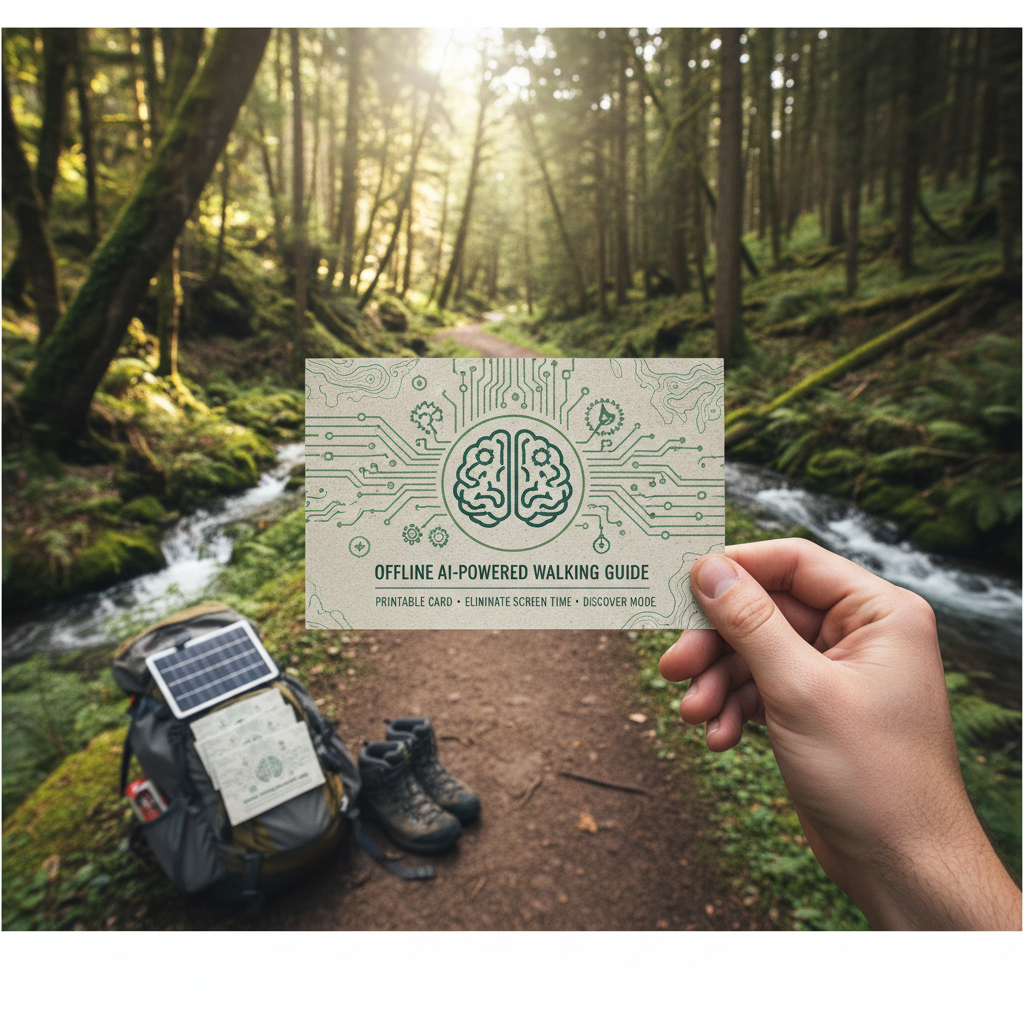
The offline‑first model for guided outdoor exploration has emerged as a compelling alternative to app‑centric experiences. A recent submission to the Hacktoberfest Open‑Source AI Challenge demonstrates this trend through a lightweight web page that creates a printable walk card. The card, generated locally, enables users to detach from their devices while still benefiting from AI‑generated prompts.
How It Works
Users interact with a single HTML page that presents dropdown menus for time availability, location type, and mood. Upon submission, the page sends these preferences along with any recent walk notes to a local AI model via Ollama’s API. The model returns a short, context‑aware set of observations—such as “Notice the variation in leaf texture” or “Listen for the distant hum of traffic”—which are rendered into a printable A4 sheet. If the model is unavailable, a fallback list of generic prompts ensures the experience remains functional offline.
Technical Details
- Model: gemma3:1b, an open‑weight language model running locally on the user’s machine.
- Front‑End: a single HTML file with vanilla JavaScript that orchestrates form data collection, local storage handling, and API communication.
- Local Storage: recent walk notes are preserved in the browser’s localStorage, guaranteeing privacy and preventing data exfiltration.
- Resilience: the fallback prompt list is bundled within the page, ensuring that users can still generate a card without a network connection.
User Experience
After printing, the card occupies the user’s hand while they step outside. The screen is used for only a minute, after which the focus shifts entirely to the surrounding environment and the pen. Following the walk, users can annotate the card with a one‑line note, which is automatically incorporated into subsequent prompt sets to avoid repetition. This minimalistic workflow encourages mindful observation and reduces digital dependency.
Impact
By leveraging a local model, the project sidesteps subscription costs and eliminates the need for an API key, making it accessible to anyone with a laptop. The privacy‑first design ensures that personal observations never leave the device, addressing growing concerns over data sovereignty. Moreover, the offline nature of the tool makes it suitable for areas with limited connectivity, aligning with the challenge’s “Touch Grass” theme of fostering real‑world interaction.
Community and Resources
The source code is openly available on GitHub at https://github.com/jeetsingh008/PaperWalk. The repository contains a README with step‑by‑step instructions for setting up Ollama and running the local model. Additional projects in the same vein—such as Paperwalk and Fieldcard—highlight the growing ecosystem of offline, AI‑driven walking experiences.
By combining local AI inference with a paper‑based activity, the project provides an elegant solution to the pervasive issue of screen over‑use, while empowering users to reconnect with their surroundings.
Leave a Reply